
0
0
Fundraising Verse of the Week

Why a Feasibility Study?

“Suppose one of you wants to build a tower. Won’t you first sit down and estimate the cost to see if you have enough money to complete it?” Luke 14:28

Jesus had no patience for half-built towers. In Luke 14, he makes it plain: before you build, sit down and count the cost. Starting well is not enough. You must know what it will take to finish before you ever break ground.

Bill leads a social service ministry and wanted to launch a housing initiative. He believed his message was compelling and skipped the feasibility study. He announced the campaign at his gala assuming donors would jump in. They didn’t and his campaign stalled.

When a ministry feels the stirring to launch a capital campaign, the natural impulse is to move fast. The need is real. The vision is compelling. The board is excited. So why slow down? Because a feasibility study will reveal four things you cannot afford to move forward without knowing.

Readiness. Is your organization healthy enough to run a campaign right now? Your donors are already asking whether your leadership, staff, and board are capable of carrying this through, even if they have never said it out loud. A feasibility study is not a sign of weak faith, it is wise stewardship.

Clarity. Do your donors understand and believe in the vision? A feasibility study forces you to write down your specific plans. It tests your assumptions by giving your best donors the chance to speak honestly before they are ever asked to give. You learn what resonates, what concerns them, and whether your goal is too low, too high, or right on target.

Relationships. Your top ten donors will make or break your campaign. If they are behind your project, you will reach your goal. If they are reluctant, your project is in jeopardy. A feasibility study also surfaces who those donors know, opening doors to new relationships that can strengthen the campaign.

Money. Launching a campaign without knowing your donors’ capacity and conviction is like building on sand. The feasibility study asks donors directly whether they support the project and what they might consider giving. That intelligence does not just tell you if the goal is reachable. It tells you how to ask, who to ask first, and what will move them to say yes. Campaigns that skip this step launch with fanfare and quietly fall short, leaving donors skeptical and leaders discouraged.

The feasibility study tells you whether you have enough of all four to proceed, and if not, what needs to be strengthened first.

Bill wishes he had slowed down. You don’t have to make the same mistake.

Think About This: Jesus said the man who starts a tower without counting the cost will be mocked when he cannot finish it. The feasibility study is how you avoid that outcome. It is how you honor your donors, protect your organization, and steward the vision God has given you.

Response: Father, give us the wisdom to count the cost before we build, the courage to ask hard questions, and the faith to trust what you reveal. May every campaign we launch bring glory to you and blessing to those we serve.

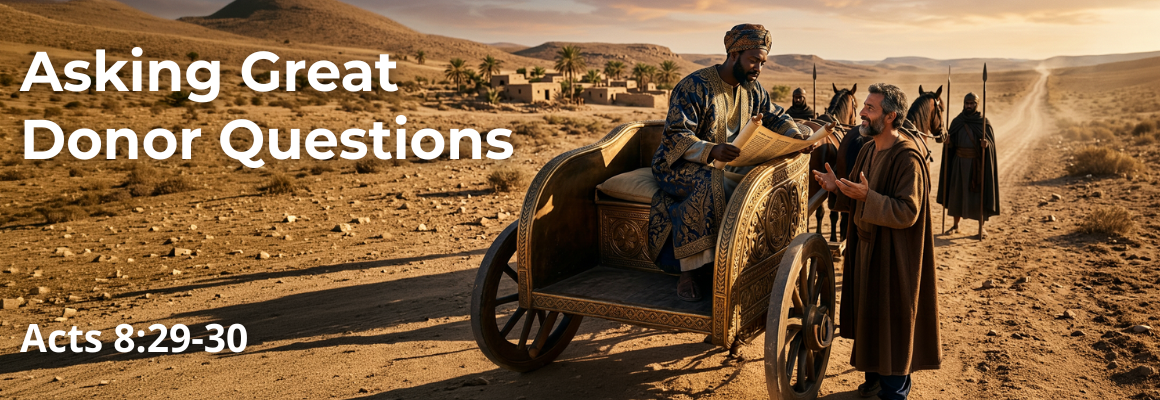
Header image for 'Asking Great Donor Questions' devotional, illustrating Acts 8:29-30: Philip the evangelist stands beside the Ethiopian eunuch's chariot in a desert landscape at sunset, engaging him in conversation as he reads from a scroll
Fundraising Verse of the Week

Asking Great Donor Questions

“The Spirit told Philip, ‘Go to that chariot and stay near it.’ Then Philip ran up to the chariot and heard the man reading Isaiah the prophet. ‘Do you understand what you are reading?’ Philip asked” Acts 8:29-30.


Ever get tongue-tied around someone of significant wealth? You’re not alone. Most of us do.

And if we’re honest, there’s something else going on too. We sometimes wonder if we’re being genuine or just working an angle. That tension is real. But the best major donor conversations happen when you stop thinking about the gift and start getting genuinely curious about the person.

Philip found himself next to one of the most important people in Ethiopia, a man who managed the queen’s entire treasury. He didn’t freeze up or launch into a pitch. He asked a question and listened. The Spirit had already gone ahead of him. Philip just showed up ready to engage.

That’s a pretty good model for your next donor visit. Instead of rehearsing what you’re going to say, show up ready to ask and ready to listen. Here are some questions to get a real conversation going.

Break the ice

  • “How did you first get connected with us?”
  • “What do you enjoy doing when you’re not working?”

Find out what they care about

  • “What causes are closest to your heart right now?”
  • “Is there a problem in the world you’d really love to see solved in your lifetime?”
  • “Was generosity something you grew up with, or did it develop later in life?”

Understand how they think about giving

  • “Do you tend to give broadly, or go deep with a few organizations you really believe in?”
  • “What’s the most meaningful gift you’ve ever made, and what made it feel that way?”

Learn how they see your work

  • “What’s your honest impression of what we’re doing?”
  • “If you could see us accomplish one thing in the next five years, what would it be?”

Listen for the longer view

  • “When you think about the difference you want to make with your resources, what comes to mind?”
  • “What do you hope your giving says about what mattered to you?”

A few things to keep in mind. Open-ended questions almost always beat yes-or-no ones. On a first visit, your goal isn’t to make an ask. It’s to understand the person in front of you. Aim to listen 70% of the time. And the most useful follow-up to almost anything a donor says is simply this: “Tell me more about that.”

Think about this: The Spirit told Philip exactly which chariot to approach. He didn’t figure that out on his own. Then Philip asked one good question, and a man’s life was changed forever. You don’t have to manufacture the right conversations. Ask the Lord to order your steps. He knows who is ready, and He can get you there.

Response: Father, guide my steps to those You’ve already prepared. Help me listen more than I talk. Help me care more about the person in front of me than the gift I’m hoping for. And let our conversations matter, for their sake, not just ours. Amen.

Close-up of a runner's legs and feet mid-stride on a dirt path at sunset, backlit with warm golden light and greenery along the trail. Text overlay reads "Press Toward Your Fundraising Goal — Philippians 3:14."
Fundraising Verse of the Week

Press Toward Your Fundraising Goal

“I press on toward the goal for the prize of the upward call of God in Christ Jesus.” Philippians 3:14

Paul paints a picture of a runner pressing toward the finish line, “straining toward what is ahead” (Philippians 3:13). Think of the marathon runner in the final mile, lungs burning, legs weak but still moving forward on nothing but will and the sight of the finish line.

That describes fundraising. The calls that go unreturned for weeks. The major donor who leaned in and then went completely silent. The board member who wants results but doesn’t help. There comes a moment in every fundraiser’s year when exhaustion wins and you cry out like Frodo, “I can’t do this, Sam.”

Sam responded with this:

“I know. It’s all wrong. By rights we shouldn’t even be here. But we are. It’s like in the great stories, Mr. Frodo. The ones that really mattered. Full of darkness and danger they were. And sometimes you didn’t want to know the end. Because how could the end be happy? How could the world go back to how it was when so much bad had happened? But in the end, it’s only a passing thing, this shadow. Even darkness must pass. A new day will come. And when the sun shines it will shine out the clearer. Those were the stories that stayed with you. That meant something, even if you were too small to understand why. But I think, Mr. Frodo, I do understand. I know now. Folk in those stories had lots of chances of turning back, only they didn’t. They kept going, because they were holding on to something… That there’s some good in this world, Mr. Frodo. And it’s worth fighting for.”

You Are in a Great Story
Sam refused to let darkness have the final word. That is exactly the attitude you need. Every unreturned call, every campaign that stalls, every board that is losing hope, these are not signs that God has abandoned your ministry. They are the middle of the story, and the middle is always the hardest part. You are not failing. You are in the part that requires patient endurance.

The Challenges Are Real
College presidents wrestle with declining enrollment and strained budgets. Rescue mission directors watch the need grow while their giving base shrinks. Christian school leaders pour energy into a major donor that always feels one conversation away from a breakthrough. The details differ. The exhaustion is the same. You are not imagining it.

Keep Going
Selah’s “Press On” was released just one month before September 11, 2001. In the following weeks, radio stations played it on heavy rotation while the nation tried to find its footing.

“When the choices are hard, when we’re battered and scarred | When we’ve spent our resources | When we’ve given our all | In Jesus’ name, we press on.”

That is still the word. Press on.

Think About This: Are you carrying a burden right now that feels too heavy to finish? Tell the Lord exactly where you are. He already knows.

Response: Lord, help me see your plan in a dark moment. Give me strength and courage to keep pressing on toward my fundraising goal, trusting you for the results. Amen.

A shepherd walks along a hilltop ridge at golden hour, leading a long line of sheep silhouetted against a bright orange sunset sky. Text overlay reads "Luke 15:4 — Fundraiser, Find Me!"
Fundraising Verse of the Week

Fundraiser, Find Me!

“Suppose one of you has a hundred sheep and loses one of them. Doesn’t he leave the ninety-nine in the open country and go after the lost sheep until he finds it?” (Luke 15:4)

Have you heard of Jose Monkey? He is a YouTube creator who specializes in geolocation. Viewers film a 360-degree video at a mystery location and submit it with the challenge, “Jose Monkey, Find Me!” Jose scours the footage for clues: a fuzzy street sign, a distant mountain range, a bend in a river. He cross-references what he sees on Google Maps, Street View, and satellite imagery until he pinpoints the spot. Some searches take minutes. A few take hours. But when he lands on it, he announces with quiet satisfaction, “Guys, that was it.”

Jose says finding someone takes three things: clever deductions, technical skill, and pure determination. That is also a pretty good job description for a gift officer pursuing lapsed donors.

Clever Deductions
The shepherd had no GPS. He followed tracks. He spotted a tuft of wool snagged on a thornbush. He read the landscape and pieced together a trail. When a donor goes quiet, retrace their steps. When did they last give? Did they attend an event? Was there a meeting that never got a follow-up? This is exactly why thorough CRM records matter. Log every gift, every email, every conversation. You are leaving a trail for the next person who needs to find what you almost lost.

Technical Skill
The internet rewards the patient researcher. LinkedIn reveals career history. Facebook surfaces family milestones. Local newspaper archives capture business news and community involvement. Obituaries are some of the greatest research tools because they map family trees and open doors to relatives you never knew were connected to your mission. Wealth screening tools go further still, surfacing property holdings, business interests, foundation affiliations, and giving history. Do your homework before you make the call.

Pure Determination
We read about the shepherd finding his sheep and skip straight to the celebration. Think about what came between. The terrain was rough. It may have been dark. There were real reasons to stay by the fire. He went anyway. Re-engaging a lapsed donor can take a week or a year. Do not give up too soon.

The Human Connection
Jose Monkey doesn’t ask for help, but you should. Sometimes the door is locked and you need a friend with a key. Jeff had the right phone number, but his donor William used call-screening software that blocked unrecognized voices. So, Jeff called their mutual friend Joe and asked him to give William a heads-up. Joe made the call. The door opened. The warmest path back to a relationship is often through someone they already trust.

Think About This: The shepherd found his sheep and threw a party. That is the energy you bring to re-winning a donor. Someone who once believed in your mission enough to give is worth every clue followed, every search run, every awkward ask of a mutual friend. Go find them.

Response: Lord, guide me to the donors who have drifted away. Open the right doors and bring the right friends alongside. Give me the patience to search well and the joy of finding what was lost. Amen.

A weathered wooden table with clay bowls, fishing nets, and a hand holding a fish in a rustic biblical-era setting, with the text The Right Fundraising Guide and the scripture reference Matthew 17:27 in white lettering.
Fundraising Verse of the Week

The Right Fundraising Guide

“But so that we may not cause offense, go to the lake and throw out your line. Take the first fish you catch; open its mouth and you will find a four-drachma coin. Take it and give it to them for my tax and yours” (Matthew 17:27).

Expert fishing guides spend years learning the water. They know where the fish hang out in every season, which bait produces strikes, and when the conditions are just right. Hire one and they will put you on the fish every time.

The disciples had a tax problem and Jesus offered a simple solution: one line, one fish, one coin. In this miracle, Jesus is the guide. He knew exactly where to fish, what to expect, and what it would provide. It was exactly the right amount at exactly the right time, delivered in a way no one could have planned.
Legendary fundraising consultant Jerry Panas spent decades studying what separates successful major gift asks from unsuccessful ones. His Six Rights of Fundraising states: “Successful fundraising is the right person asking the right prospective donor for the right amount for the right project at the right time in the right way.”

The Right Person. The asker must have a genuine personal connection with the donor or bring someone along who does. Before you ask, build the bridge.

The Right Prospective Donor. Your goal is finding the person who has the capacity and the calling to make a difference. Capacity without passion and passion without capacity both fall short of transformational giving.

The Right Amount. Ask too low and you leave resources on the table. Ask too high without preparation and you damage the relationship. Do your homework and be willing to name a number with confidence.

The Right Project. Some donors love capital projects. Others want to fund programs that change lives directly. Listen well to match their heart to the right opportunity.

The Right Time. Timing in fundraising is not about your calendar. It is about the donor’s life and readiness. Stay in relationship, stay patient, and stay attentive.

The Right Way. The best fundraisers are the best listeners. Listening equips you to craft an ask that feels personal rather than scripted. That kind of ask is hard to say no to.

The Seventh Right: The Right Prayer. Panas set the table beautifully but overlooked the most important element: prayer.

You can execute all six rights flawlessly and still walk away without a gift. Your skill and strategy can put you in the right room at the right moment, but only the Holy Spirit can move a heart to be generous. Before every major ask, pray specifically. Ask the Spirit to identify the right donor, give you wisdom about the right amount, and prepare the donor’s heart before you ever sit down with them. Then release the outcome. Your job is faithfulness. The results belong to God.

Think About This: We share the story. We make the ask. But we cannot manufacture the response. That has always been the work of the Spirit.

Response: Lord, lead me to the donor you have already prepared, give me wisdom for the right ask, and remind me that what I cannot manufacture, you can simply speak into being. Amen.

A lone figure standing on a mountain summit overlooking a sweeping valley at sunrise, with the text God's Role in Your Fundraising Challenge and the scripture reference 2 Chronicles 20:17 in white lettering.
Fundraising Verse of the Week

God’s Role in Your Fundraising Challenge

“You will not have to fight this battle. Take up your positions; stand firm and see the deliverance the Lord will give you, Judah and Jerusalem. Do not be afraid; do not be discouraged. Go out to face them tomorrow, and the Lord will be with you” (2 Chronicles 20:17).

A vast army was knocking on Jerusalem’s door. Instead of panicking, King Jehoshaphat gathered the people to fast and seek the Lord. He confessed: “We do not know what to do, but our eyes are on you” (2 Chronicles 20:12). Jahaziel prophesied, “The battle is not yours but God’s… You will not have to fight.” They needed only to take their positions, stand firm, and watch God’s deliverance unfold. From Jehoshaphat’s crisis response, we discover four fundraising principles.

Pray Up
When Martin Luther had much to do, he would spend the first three hours in prayer. How important is prayer in your fundraising efforts? Do you spend more time planning or praying? Do you pray for your major donors by name? Do you pray that God will bless their families, their health, their businesses? Jehoshaphat invited all Israel to pray for their deliverance. You should invite your board, staff, and volunteers to pray for God’s blessing on your fundraising efforts.

Suit Up
Israel was commanded to “take up your positions; stand firm.” Fundraising is spiritual warfare. Satan doesn’t want your ministry partners to give generously because he doesn’t want your ministry to succeed. He will oppose you in every way possible. You’ll schedule the meeting, and your donor will get called away on emergency business. Paul instructs us to “put on the full armor of God, so that you can take your stand against the devil’s schemes” (Ephesians 6:11). Your shield of faith reminds you this isn’t about your effort but God’s provision.

Show Up
“Go out to face them tomorrow, and the Lord will be with you” (2 Chronicles 20:17). Fundraising isn’t passive,  it’s active. You’ve got to pick up the phone and call your donors. You might need to call fifteen times before you finally connect. You’ve got to go see your donors face-to-face and share your vision. You’ve got to listen to their hearts and learn what matters to them. Woody Allen said, “80% of success is showing up.” You cannot merely “phone it in” you have to show up.

Look Up
God places you in situations that seem overwhelming so you will learn to rely on him. In this battle, Israel didn’t fight at all. They worshiped their way to victory. When you’ve prayed up, suited up, and shown up, your job is to trust God for the outcome. Judah spent three days collecting abundant plunder. You can’t manufacture generosity. Only the Holy Spirit can move someone’s heart to give sacrificially.

Think About This: Spirit-led fundraising is knowing when to listen and when to speak. Sometimes it’s asking for the gift. Sometimes it’s simply showing up to collect the check God has already prepared.

Response: Lord, help me faithfully pray for my donors. Give me courage to suit up spiritually before every meeting. Help me show up consistently, even when it’s hard. Remind me to look up, trusting you to fight my battles.

Nighttime nativity silhouette with a bright star shining over a manger and three wise men on camels, set against a star-filled sky, with text reading The Indescribable Gift.
Fundraising Verse of the Week

The Indescribable Gift

“Thanks be to God for his indescribable gift!” (2 Corinthians 9:15)

We take great care when selecting the perfect gift for that special person, but nothing compares with our Heavenly Father’s gift of his only Son to be “an atoning sacrifice for our sin” (1 John 4:10). Praise God for his generous, sacrificial gift of salvation! Without God’s generosity to us, we would be eternally lost and without hope. Paul responded to God’s gift with this doxology of praise. How should you respond to the generosity of your donors? Gifts from your ministry partners accomplish four results.

Practical
Henry Ford said, “Nothing happens until someone sells something.” In ministry, nothing happens until someone gives something. Generosity starts a chain reaction of blessing. “This service that you perform is… supplying the needs of the Lord’s people” (2 Cor. 9:12). Gifts solve real problems and enable you to serve others. With a balanced budget you can educate more students, feed more hungry people, and reach more people with the Gospel. More money means more ministry.

Personal
Your ministry benefits when donors give, their generosity also demonstrates the genuineness of their faith. Because of the service by which you have proved yourselves” (2 Cor. 9:13). Giving is an expression of “the obedience that accompanies your confession of the gospel of Christ” (vs. 13). James warns us that faith without works is dead. What good is it, my brothers and sisters, if someone claims to have faith but has no deeds? Can such faith save them?  Suppose a brother or a sister is without clothes and daily food. If one of you says to them, ‘Go in peace; keep warm and well fed,’ but does nothing about their physical needs, what good is it?” (James 2:14-16). Giving transforms mere talk into action.

Praise
Generous giving prompts “many expressions of thanks to God” (vs. 12). Great news about a generous gift spreads like wildfire. “Others will praise God for… your generosity in sharing with them and with everyone else” (2 Cor. 9:13). Share with your donors how their gift is making an eternal difference and how your whole team is thanking God because of their generosity. Tell an impact story that would not have happened without their gift. Thank them for sharing with you and the other ministries they support.

Prayer
We are encouraged to pray for missionaries who are sharing the gospel throughout the world. Many donors don’t realize that those who benefit from their generosity are also praying for them. “And in their prayers for you their hearts will go out to you, because of the surpassing grace God has given you” (vs. 14). The greatest way to thank your donors is to pray for them. Ask for their prayer requests, spend time praying for them, and follow up to hear how God has answered.

Think About This: So many great things happen when donors give generously. You have the privilege of asking your donors to partner with you to accomplish eternal work. This week thank your donors for their generous, sacrificial gifts to your ministry.

Response: Father, I am so thankful to you for our donors. Please help me express my gratefulness to my donors in ways that give you all the glory.

Silhouette of a person kneeling in prayer at sunset by the ocean, with the words 'James 5:16 P.U.S.H. Fundraising' overlaid on the image.
Fundraising Verse of the Week

P.U.S.H. Fundraising

“The prayer of a righteous person is powerful and effective” (James 5:16).

Elijah prayed and it did not rain for three and a half years. Imagine forty-two months without rain—rivers dwindle to a trickle, lakes evaporate, crops fail, livestock die of thirst, and hope slowly fades. Elijah prayed again and “the heaven gave rain and the earth produced its crops” (James 5:18).  It wasn’t a quick “bless the missionaries” prayer. Seven times he prayed and asked his servant to look to the sky for answers. Six times the servant saw nothing, but the seventh time he saw “a cloud as small as a man’s hand rising from the sea” (1 Kings 18:44). God opened the windows of heaven because of Elijah’s persistent prayer.

Are you experiencing a budget drought? You need P.U.S.H. Fundraising—Pray Until Something Happens. Often, we stop praying after one or two anemic prayers, but God answers when we persevere. Sure, you pray to meet your budget, but do you pray for the individuals who can help you meet your budget? If you only know your donors by their I.D. numbers, you can only pray in generalities. But if you know your donors intimately, you can pray with understanding. Paul prayed these requests for the Colossian believers (see Col. 1:9-10).

Know God’s will. “We continually ask God to fill you with the knowledge of his will through all the wisdom and understanding that the Spirit gives” (v. 9).
Knowing and doing God’s will is top of mind for every believer who wants to wholeheartedly serve the Lord. Your ministry partners need knowledge, wisdom, and understanding to make good stewardship decisions.

Live worthy. “Live a life worthy of the Lord” (v.10).
To walk worthy means our actions match our words. Sincere believers don’t say one thing and do another. Wealth comes with many temptations. Unfortunately, many “have wandered from the faith and pierced themselves with many griefs” (1 Tim. 6:10). Pray for your ministry partners to live their faith, not merely profess it.

Please God. “Please him in every way” (v. 10).
In the last days, people will be “lovers of pleasure rather than lovers of God” (2 Tim. 3:4). Pray your donors will not be swayed by “the worries of this life, the deceitfulness of wealth and the desires for other things” (Mark 4:19). Your donors need wisdom to please the Lord in their money management, especially their giving.

Bear fruit. “Bearing fruit in every good work” (v. 10).
Jesus taught, “If you remain in me and I in you, you will bear much fruit; apart from me you can do nothing” (John 15:5). Pray your ministry partners will remain in Christ and bear fruit that lasts. Hudson Taylor said, “The Lord’s work done in the Lord’s way will never fail to have the Lord’s provision.” In response Francis Shaefer observed, “The Lord’s work done in human energy is not the Lord’s work any longer. It is something, but it is not the Lord’s work.”

Think About This: If God answered all your prayers, would it change the world and your ministry partners, or just your budget?

Response: Father, please help me pray specifically for our donors to seek your will and bear much fruit through their generosity.

A group of people stands together at sunset, silhouetted against the sky with their arms raised in celebration. The warm colors of the setting sun create a vibrant and uplifting atmosphere. The text "Fundraise at the Speed of Relationships" is prominently displayed at the top, with a reference to 1 Thessalonians 2:1. This image conveys themes of teamwork, unity, and the power of relationships in fundraising.
Fundraising Verse of the Week

Fundraise at the Speed of Relationships

“You know, brothers and sisters, that our visit to you was not without results” (1 Thess. 2:1).

Paul spent three weeks in Thessalonica proving why Jesus had to suffer and rise from the dead. Some Jews believed, along with some God-fearing Greeks, and several prominent women. The Jewish leaders were jealous of Paul’s success and recruited some bad dudes from the marketplace to start a riot which forced Paul and Silas to escape during the night (see Acts 17:1-9). Paul was only in town for a brief time, but he developed some deep friendships and successfully planted a church.

Cultivating friendships is a vital step in fundraising, yet it doesn’t have to take years and years or even months to establish meaningful relationships with major donors. Let’s apply five fundraising principles from Paul’s experience.

Love
Sincere friendships are built on love. Paul expressed, “Because we loved you so much, we are delighted to share with you not only the gospel of God, but our lives as well” (1 Thess. 2:8). Paul didn’t just talk about love, he lived it. You can feel it when you’re the presence of a ministry leader who really loves you. Be that person. You can also tell if someone is insincere.

Genuineness
The believers in Thessalonica knew Paul was the real deal. His motives were pure, he never tricked them, never used flattery, never put on a mask to cover up greed, or sought praise from anyone (1 Thess. 2:3-4). Unfortunately, Christian ministries are full of posers. Be transparent in your finances, relationships, board decisions, and plans.

Hard Work
Paul had a reputation for diligence. “Surely you remember, brothers and sisters, our toil and hardship; we worked night and day in order not to be a burden to anyone” (1 Thess. 2:9). Your donors have worked hard for what they have, and they appreciate ministry leaders who also work hard. Ministry partners notice whether you have a reputation of sticking with the job until it’s done or taking extended sabbaticals.

Prayer
Imagine how encouraged you would be if Paul wrote this note to you, “We constantly pray for you that our God may make you worthy of his calling, and that by his power he may bring to fruition your every desire for goodness and your every deed prompted by faith” (2 Thess. 1:11). Do you pray for the success of your donors’ business endeavors? Have you encouraged them recently?

Answers
In 2 Thessalonians 2:1-12, Paul answered some deep eschatological questions about the antichrist. How amazing that Paul’s discipleship curriculum included a section on prophecy. “Don’t you remember that when I was with you, I used to tell you these things?” (2 Thess. 2:5). This should encourage you to have deep conversations about your ministry’s mission and vision. Don’t shy away from difficult topics. Iron sharpens iron and your key donors look to you for answers to tough questions.

Think About This: Everyone wants their major donor relationships to move fast, but few are willing to invest in the hard work of building trust. Be intentional about every major donor move.

Response: Father, thank you for our faithful donors—old and new. Give me wisdom to identify, cultivate, and solicit new ministry partners.

Close-up of a sturdy brass padlock securing a bright blue metal door. Text overlay reads 'The Major Gift Lockpicking Tool,' suggesting a metaphor for unlocking opportunities. Simple, bold design with a focus on the lock.
Fundraising Verse of the Week

The Major Gift Lockpicking Tool

“A gift opens the way to the giver and ushers the giver into the presence of the great” (Proverbs 18:16).

The Lockpicking Lawyer, a YouTube content creator who opens “unpickable” locks, received an interesting challenge. A viewer, whose local locksmith had resorted to using an angle grinder to open a lock, sparked a heated debate. The viewer insisted the Lockpicking Lawyer could have picked it, while the locksmith dismissed his videos as fake. The challenge was set: if the Lockpicking Lawyer could pick the lock faster than the time it took to cut it with an angle grinder, the locksmith would refund the viewer $75. While the angle grinder took two minutes and fourteen seconds, the Lockpicking Lawyer needed only 28 seconds to pick the lock.

One frustrating reality for every fundraiser is the inability to open a major donor door. Every attempt to reach a prospect feels more difficult than breaking into Fort Knox. Solomon reveals the key to connecting with any major donor prospect is to offer a gift.

A Personal Gift
Who doesn’t like to receive a gift? When choosing a gift, don’t default to SWAG (Stuff We All Get) you hand out at a conference. Get more creative than pens emblazoned with your logo. Consider your prospect’s interests. What unique gift would your potential donor appreciate that reminds them of your ministry whenever they see it? Perhaps you could share something special from one of your noteworthy alumni.

An Opportunity Gift
Pay attention to your prospective donor’s unique interests and expertise, then create opportunities for them to share their knowledge. Business professionals might appreciate invitations to lead workshops, teach classes, or deliver keynote speeches. A prospective donor with a passion for Revolutionary War history brings history to life in full George Washington attire. A perceptive school principal invites him to captivate elementary students with his presentations. For this donor, the opportunity to share his enthusiasm for history is itself a meaningful gift.

An Honor Gift
Pay attention and acknowledge news about your prospective donor. It could be as simple as sending a note of congratulations about their business success, job promotion, or personal accomplishment like a hole-in-one or being featured in the media. One college invites their prospective donors to a banquet in their honor and presents them with an award acknowledging their contributions to the community.

The Gift of Prayer
One simple way to make a meaningful connection is to offer to pray for your prospective donors. You may never have met that person but offering to pray may open a door for a future conversation. Perhaps they or a family member have experienced a personal tragedy and your offer to pray brings comfort and encouragement. Perhaps they’ve experienced great success and your prayers will remind them to give glory to God. The key is connecting with them spiritually.

Think About This: The greatest gift you could ever give your prospective donor is the gift of the Good News. Perhaps you could share a book, music, or video from your ministry that includes a gospel presentation.

Response: Father, please give me wisdom to choose the best gift that will open major donor doors. Thank you for sharing the greatest gift, your Son, Jesus Christ.

1 2 3
Privacy Settings
We use cookies to enhance your experience while using our website. If you are using our Services via a browser you can restrict, block or remove cookies through your web browser settings. We also use content and scripts from third parties that may use tracking technologies. You can selectively provide your consent below to allow such third party embeds. For complete information about the cookies we use, data we collect and how we process them, please check our Privacy Policy
Youtube
Consent to display content from - Youtube
Vimeo
Consent to display content from - Vimeo
Google Maps
Consent to display content from - Google
Spotify
Consent to display content from - Spotify
Sound Cloud
Consent to display content from - Sound
Cart Overview