


0
0
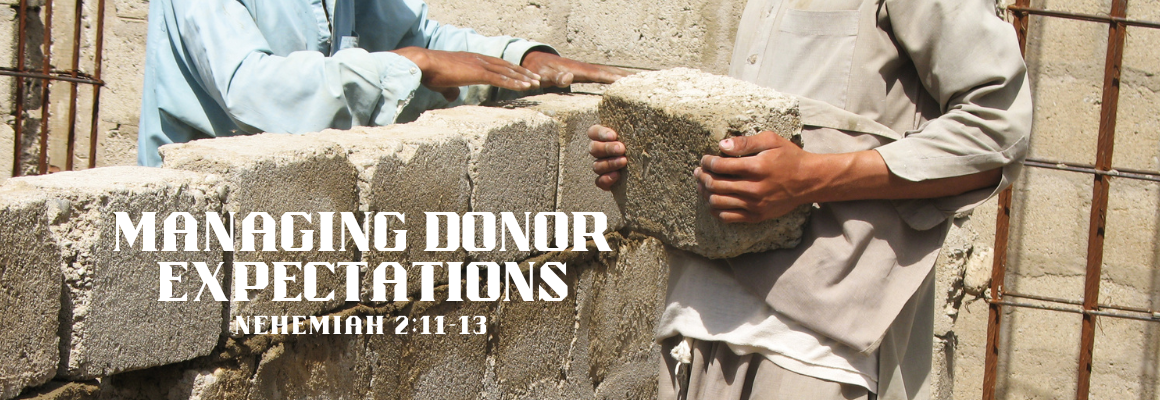
Two workers building a stone wall, each holding large concrete blocks, with the title Managing Donor Expectations overlaid on the image.
Fundraising Verse of the Week

Managing Donor Expectations

โ€œI went to Jerusalem, and after staying there three days I set out during the night with a few others. I had not told anyone what my God had put in my heart to do for Jerusalemโ€ (Nehemiah 2:11-12).

Nehemiah was on a mission from God to rebuild the walls of Jerusalem. He asked King Artaxerxes for help and the king miraculously gave him time off, safe passage, and timber to make beams for the gates. He even sent along army officers and cavalry (see Neh. 2:7-9). Nehemiah could have marched into Jerusalem with pomp and circumstance; instead, he arrived unassumingly. We can learn much from Nehemiah about communicating vision and creating buy-in.

Listen
Leaders have many voices vying for their attention, especially when it comes to fundraising. Everybody has an agenda and wants to fund their pet project. Itโ€™s easy for leaders to become people-pleasers and attempt to make everyone happy, but the most important voice to hear is Godโ€™s. Nehemiah was keenly aware of what God called him to do and he wasnโ€™t going to let anything, or anyone stand in his way. What is God telling you to accomplish for his glory?

Learn
After three days in Jerusalem, Nehemiah decided to inspect the walls for himself. He didnโ€™t tell โ€œthe Jews or the priests or nobles or officials or any others who would be doing the workโ€ (Neh. 2:16). Instead, he took a few confidants on a night vision tour around the wall. Nehemiah was careful not to raise expectations before he had a clear understanding of what needed to be accomplished. Donโ€™t cast a vision before you have a solid plan to carry it out.

Lead
When Nehemiah finished his due diligence, he preached a three-point sermon: (1) We have a serious problem, (2) God has already provided our answer, (3) Now is our time to respond (see Neh. 2:17). Share this same appeal with your donorsโ€”the problem, your solution, Godโ€™s provision, and a call to action. Perhaps Nehemiah sounded something like William Wallaceโ€™s rousing speech in Braveheart, โ€œtheyโ€™ll never take our freedom!โ€ His pep talk worked because all the people replied, โ€œLetโ€™s start rebuildingโ€ (Neh. 2:18).

Look Out
When you take a stand for the Lord, your enemies will spring into action. Sanballat, Tobiah, and Geshem were quick to mock and ridicule Nehemiah and the people. As an anonymous WWII bomber pilot said, โ€œThe flak only gets heavy when youโ€™re over the target.โ€ Nehemiah didnโ€™t let criticism paralyze him. โ€œThe God of heaven will give us success. We his servants will start rebuilding, but as for you, you have no share in Jerusalem or any claim or historic right to itโ€ (Neh. 2:20).

Think About This: Creating buy-in is ultimately about influencing others, not making demands on them. Nehemiah invited the people to join him in the work, โ€œCome, let us rebuild the wall of Jerusalem, and we will no longer be in disgraceโ€ (Neh. 2:17). Donโ€™t demand a gift from your donors, invite them to partner with you in the great work God has called you to accomplish.

Response: Lord, help me listen to your voice so I can inspire our donors to accomplish the tasks youโ€™ve marked out for us (see Heb. 12:1).

Flat lay of a dark desk with a laptop, coffee cup, notebook, pen, and wireless earbuds, with the text "Worldโ€™s Best Fundraising Boss โ€“ Ruth 2:8" on the left side.
Fundraising Verse of the Week

World’s Best Fundraising Boss

So Boaz said to Ruth, โ€œMy daughter, listen to me. Donโ€™t go and glean in another field and away from here. Stay here with the women who work for meโ€ (Ruth 2:8).

One of the biggest fundraising challenges is retaining talent. The average development staff tenure is 24 months. Fundraising can be fast-paced, stressful, frustrating, and exhausting. Some people simply burn out and give up. Staff leave for many reasons, but common complaints are unrealistic expectations, low appreciation, and toxic work environments. People usually quit their boss before they quit their job. How can you foster a healthy atmosphere where your team loves to come to work? Boaz earned his โ€œWorldโ€™s Best Bossโ€ coffee mug with these six leadership actions:

Lead Spiritually
Every day Boaz greeted his harvesters with, โ€œThe Lord be with youโ€ (Ruth 2:4) and his staff responded in kind. As the fundraising leader, you should create a healthy spiritual atmosphere. Do you model the fruit of the Spirit: โ€œlove, joy, peace, forbearance, kindness, goodness, faithfulness, gentleness, and self-controlโ€ (Gal. 5:22-23)?

Ask Questions
โ€œBoaz asked the overseer of his harvesters, โ€˜Who does that young woman belong to?โ€™โ€ (Ruth 2:5). Boaz didnโ€™t treat his employees as nameless faceless tools to accomplish a job. One absent-minded executive always called his maintenance director โ€œRodโ€ when his name was Rob. Boaz showed a personal interest in each one to learn their story.

Provide Training
Some onboarding processes are atrocious. We teach people how to swim by throwing them into the deep end of the pool. Boaz gave Ruth specific instructions, โ€œWatch the field where the men are harvesting, and follow along after the womenโ€ (Ruth 2:9). Give your team the proper training they need to be successful.

Create Safety
โ€œI have told the men not to lay a hand on youโ€ (Ruth 2:9). Itโ€™s sad to hear when Christian ministries have allowed employees to make inappropriate remarks to their female staff members. Paul was clear about avoiding sinful communication, โ€œNor should there be obscenity, foolish talk or coarse joking, which are out of place, but rather thanksgivingโ€ (Eph. 5:4).

Show Grace
Boaz instructed his team, โ€œLet her gather among the sheaves and donโ€™t reprimand her. Even pull out some stalks for her from the bundles and leave them for her to pick up, and donโ€™t rebuke herโ€ (Ruth 2:15-16). Show grace to your new team members as they learn your system and give them quick wins to build their confidence.

Be Kind
Boaz welcomed Ruth to the team by (a) offering her cool water (2:9), (b) inviting her to sit with them at mealtime (2:14), and (c) speaking encouraging words to her. โ€œMay I continue to find favor in your eyes, my lord,โ€ she said. โ€œYou have put me at ease by speaking kindly to your servantโ€”though I do not have the standing of one of your servantsโ€ (Ruth 2:13).

Think About This: Ruth stayed because Boaz specifically asked her to stay. โ€œDonโ€™t go and glean in another field and donโ€™t go away from here. Stay here with the women who work for meโ€ (Ruth 2:8). Donโ€™t assume that your staff know how much you appreciate them. Tell them.

Response: Father, help me reflect Christโ€™s love and kindness to my team.

A group of people stands together at sunset, silhouetted against the sky with their arms raised in celebration. The warm colors of the setting sun create a vibrant and uplifting atmosphere. The text "Fundraise at the Speed of Relationships" is prominently displayed at the top, with a reference to 1 Thessalonians 2:1. This image conveys themes of teamwork, unity, and the power of relationships in fundraising.
Fundraising Verse of the Week

Fundraise at the Speed of Relationships

โ€œYou know, brothers and sisters, that our visit to you was not without resultsโ€ (1 Thess. 2:1).

Paul spent three weeks in Thessalonica proving why Jesus had to suffer and rise from the dead. Some Jews believed, along with some God-fearing Greeks, and several prominent women. The Jewish leaders were jealous of Paulโ€™s success and recruited some bad dudes from the marketplace to start a riot which forced Paul and Silas to escape during the night (see Acts 17:1-9). Paul was only in town for a brief time, but he developed some deep friendships and successfully planted a church.

Cultivating friendships is a vital step in fundraising, yet it doesnโ€™t have to take years and years or even months to establish meaningful relationships with major donors. Letโ€™s apply five fundraising principles from Paulโ€™s experience.

Love
Sincere friendships are built on love. Paul expressed, โ€œBecause we loved you so much, we are delighted to share with you not only the gospel of God, but our lives as wellโ€ (1 Thess. 2:8). Paul didnโ€™t just talk about love, he lived it. You can feel it when youโ€™re the presence of a ministry leader who really loves you. Be that person. You can also tell if someone is insincere.

Genuineness
The believers in Thessalonica knew Paul was the real deal. His motives were pure, he never tricked them, never used flattery, never put on a mask to cover up greed, or sought praise from anyone (1 Thess. 2:3-4). Unfortunately, Christian ministries are full of posers. Be transparent in your finances, relationships, board decisions, and plans.

Hard Work
Paul had a reputation for diligence. โ€œSurely you remember, brothers and sisters, our toil and hardship; we worked night and day in order not to be a burden to anyoneโ€ (1 Thess. 2:9). Your donors have worked hard for what they have, and they appreciate ministry leaders who also work hard. Ministry partners notice whether you have a reputation of sticking with the job until itโ€™s done or taking extended sabbaticals.

Prayer
Imagine how encouraged you would be if Paul wrote this note to you, โ€œWe constantly pray for you that our God may make you worthy of his calling, and that by his power he may bring to fruition your every desire for goodness and your every deed prompted by faithโ€ (2 Thess. 1:11). Do you pray for the success of your donorsโ€™ business endeavors? Have you encouraged them recently?

Answers
In 2 Thessalonians 2:1-12, Paul answered some deep eschatological questions about the antichrist. How amazing that Paulโ€™s discipleship curriculum included a section on prophecy. โ€œDonโ€™t you remember that when I was with you, I used to tell you these things?โ€ (2 Thess. 2:5). This should encourage you to have deep conversations about your ministryโ€™s mission and vision. Donโ€™t shy away from difficult topics. Iron sharpens iron and your key donors look to you for answers to tough questions.

Think About This: Everyone wants their major donor relationships to move fast, but few are willing to invest in the hard work of building trust. Be intentional about every major donor move.

Response: Father, thank you for our faithful donorsโ€”old and new. Give me wisdom to identify, cultivate, and solicit new ministry partners.

Two snails crawling on a tree branch with a soft, blurred green and yellow background. The text "Slow Downโ€”Donors Ahead" is displayed in bold, playful letters, emphasizing patience and careful engagement.
Fundraising Verse of the Week

Slow Down – Donors Ahead

โ€œEnthusiasm without knowledge is not good. If you act too quickly, you might make a mistake.โ€ (Proverbs 19:2 NCV).

Absalom orchestrated a coup against his father and started a civil war. David sent Joab and his army to crush the uprising (see 2 Samuel 18:1-33). As Absalom was fleeing for his life, he rode under an oak tree and caught his long flowing hair in the thick branches, but his mule kept on going. He hung there helplessly until Joab came and plunged three javelins into his heart killing him and ending the war.

Then an interesting event happened. Ahimaaz volunteered to run take the news to David, but Joab refused saying, โ€œYou may take the news another time, but you must not do so todayโ€ (2 Sam. 18:20). Instead, Joab assigned a Cushite to run with the message to David. Ahimaaz loved to run so much, he begged Joab for permission to go, so Joab relented. Ahimaaz took the route through the plain, outran the Cushite, and reached David first. Unfortunately, he had no message to share. David told him to step aside as they waited for the Cushite to arrive with the bad news that Absalom was dead. We can learn four fundraising lessons from this account.

Enthusiasm isnโ€™t Enough
Ahimaaz loved to run just for the sake of running. Paul taught in 1 Corinthians 9:26, โ€œTherefore I do not run like someone running aimlessly.โ€ Some fundraisers are full of zeal but donโ€™t have focus or a purpose for their donor meetings. Determine the outcomes you want to achieve for each major donor. What information do you want to learn? What messages do you want to convey and what call to action will you propose? If you donโ€™t aim at anything, you will hit it every time.

Clarify Your Message
Ahimaaz arrived first but had nothing to say. It doesnโ€™t matter if you are the first ministry to connect with a major donor; if your message is unclear, you will miss the opportunity. Donors give to ministries that have a clear vision of what they intend to accomplish. Fine tune your message to make sure itโ€™s compelling.

Donโ€™t Act Too Quickly
Slow down. A rookie fundraiser in her zeal submitted an initial grant application to a foundation for $2 million. The foundation had given grants of that size but had no relationship with her organization. She jumped the gun and missed the relationship-building step. Unfortunately, the foundation director moved her application to the circular file.

Avoid Mistakes
You never get a second chance to make a first impression. Sometimes you may never get a second chance to connect with a potential major donor. Be intentional with your major donor strategy. Make sure the right person in your ministry shares the right message at the right time.

Think About This: The speed-accuracy trade-off is a behavioral science theory that proposes decisions made slowly have high accuracy while decisions made fast have a high error rate. Donโ€™t rush your donor relationships but donโ€™t procrastinate either. John Wooden, famed UCLA basketball coach, taught his players, โ€œBe Quick, But Donโ€™t Hurry.โ€

Response: Father, give our team zeal and wisdom to make the greatest impact for you as we engage major donors.

Communication, Fundraising Verse of the Week

Cultivating Bumper Crops

โ€œJesus replied, โ€˜The hour has come for the Son of Man to be glorified.ย 24ย Very truly I tell you, unless a kernel of wheat falls to the ground and dies, it remains only a single seed. But if it dies, it produces many seedsโ€™โ€ (John 12:23-24).

Seeds are miraculous. Farmers and gardeners know that it requires the proper soil, water, temperature, and light conditions for seeds to germinate. In simple terms the seed must die to reproduce. In this verse, Jesus used seeds to picture his death and resurrection. Because of Christโ€™s deathโ€”the one seedโ€”โ€œmany will be made righteousโ€ (Rom. 5:19). Jesus invites believers to follow in his steps. โ€œAnyone who loves their life will lose it, while anyone who hates their life in this world will keep it for eternal lifeโ€ (John 12:25). God calls us to work in his harvest field, but first we must die to ourselves.

Sowing and Reaping.ย The dying seed principle applies directly to generous giving. The money we give becomes dead to us in the sense that we give up our control. God takes our seed and works a miracle to produce a harvest of righteousness in others. The sowing and reaping principle means that you reap in proportion to what you sow. If you sow with caution, you will reap a poor harvest. If you sow with abundance, you will reap a bumper crop. This truth should compel us to give as much as we possibly canโ€”and then give more!

Multiplication Factor.ย Communicateย your needs to your donors by emphasizing the eternal results their gift will produce as they partner with you. Help them understand how your ministry will multiply their gift in the lives of the people you serve directly, and how the chain reaction of one changed life will impact many others. The students you educate today will be leaders tomorrow. The homeless person you feed, clothe, shelter, and retrain now will become a productive community member in the future.

Eternal Impact.ย Often colleges and universities conduct an economic impact study demonstrating their value to the community. Frame your appeals with an โ€œeternal impactโ€ perspective proving your value to your constituency. Donors want to know that your ministry is a good investment that will produce a spiritual return on their gift. Tell your โ€œmany seedsโ€ stories to encourage your donors to plant their single seed.

ย 

Have a Spirit-led fundraising week,

Ron


Ron Haasย has served the Lord as a pastor, the vice president of advancement of a Bible college, a Christian foundation director, a board member and a fundraising consultant. Heโ€™s authored two books:ย Ask for a Fishย โ€“ Bold Faith-Based Fundraising andย Simply Shareย โ€“ Bold, Grace-Based Giving. He regularly presents fundraising workshops at ministry conferences and has written fundraising articles forย At the Center magazineย andย Christian Leadership Allianceโ€™s Outcomes magazine.

Donor Relations, Fundraising, Fundraising Verse of the Week

The 4 Little Foxes Of Donor Relationships

โ€œCatch for us the foxes, the little foxes that ruin the vineyards, our vineyards that are in bloomโ€ Song of Songs 2:15.

Itโ€™s the little things that drive wedges between you and your donors. The Bridegroom warned his Bride to catch the little foxes that would spoil their vine. In a marriage, the little differences that drew you and your spouse together can become huge annoyances if you neglect to apply love in liberal doses.

Your donor relationships are susceptible to these four little foxes:

Poor Communication.

Lack of communication is at the heart of every failed donor relationship. The problem really is lack of listening. Stephen Covey said, โ€œMost people do not listen with the intent to understand; they listen with the intent to reply.โ€ Listen to your donor more than you speak. You will learn something important about their heart.

Unmet Expectations.

Donors believe that you will use their gift for what you say you will. Unfortunately, when budgets get tight ministry leaders are often tempted to find ways to apply designated gifts to undesignated budget items. These gymnastics may cover short-term needs but will often create long-term donor problems.

Lack of Empathy.

We focus on our program and our financial needs so much that sometimes we forget to show love and compassion. A donor shared the sad story that his employee had just embezzled $150,000. Wisely, the donor representative, who was prepared to ask for $150,000 gift, kept his proposal in his folder for another day and focused on encouraging the donor in his loss.

Taking Donors for Granted.

If every conversation you have with your donors is to ask for money, you will quickly burn your relationships. Donโ€™t treat your donors like ATM machines; just push a few buttons and out pops money. Donors know when you only appreciate them for what they have and what they can give, instead of who they are.

The best way to keep these little foxes in check is with two little words: time and love. Spend time with your donors and genuinely love them. โ€œAbove all, love each other deeply, because love covers over a multitude of sinsโ€ (1 Peter 4:8).

Have a Spirit-led fundraising week!


Ron Haas, Vice President of The Timothy Group, has also served the Lord as a pastor, the vice president of advancement of a Bible college, a Christian foundation director, a board member and a fundraising consultant. Heโ€™s authored two books: Ask for a Fish โ€“ Bold Faith-Based Fundraising and Simply Share โ€“ Bold, Grace-Based Giving. He regularly presents fundraising workshops at ministry conferences and has written fundraising articles for At the Center magazine and Christian Leadership Allianceโ€™s Outcomes magazine.

Donor Relations, Fundraising, Major Donors

Low Pressure vs. Passive Donor Communications

As non-profit leaders, we all know the importance of good, ongoing communication with our supporters and friends. Communication of our message in a meaningful way is an essential part of the fundraising formula. It is important that we keep our vision out front. During this challenging time of the COVID-19 pandemic, how and when we communicate to our donors is more than just important. It is critical.

Sensitivity & Scale

Most of the non-profit ministries we work with have scaled back their communication in some way. Since we are not doing face to face donor meetings, we have turned to other means โ€“ phone, mail, email, and even virtual meetings like Zoom or Go-to-Meeting. Some would ask, does this require that we also change the message? The urgency? The frequency? Most ministries have realized the need to be sensitive to donors during this time. Many have lost money or investments and are not as prepared to make gift decisions. Some have been directly impacted by COVID in their family. Others are fearful or worried about the future.

Care Over Solicitation

 At TTG, we have discussed the need to pivot from making direct โ€œsolicitationโ€ calls to โ€œcareโ€ calls or thank-you calls. Sharing what is going on at your ministry in a low-pressure manner is a good practice as we move through these uncertain times and look forward to a season of recovery. People need to know you are still there.

Low Pressure vs. Passivity

But we should not be passive in our approach. Being passive means that you do not take action, but instead let things happen to you. Passive activity involves watching, looking at or listening to things without taking action; being inactive. This is not how we want to communicate with our donors. Being low pressure in your approach does not mean you are being passive. It simply means you are adjusting your approach to the current situation. 

One of our school clients described how they are calling their regular donors and saying, โ€œWe are still here. God is faithful. Even though we are closed to students, we still have operational needs.โ€ No direct ask was made, but they shared the need in a low pressure way. Many would respond, โ€œHow can we help?โ€ This school saw increased giving over a year ago and met their annual fund goal in the midst of COVID-19. God is faithful.

Another client, a rescue mission, reported that as they increased their focus on thank you calls, they saw a parallel increase in the number of unsolicited donations to the ministry; this included some very large gifts that were unexpected. What if they would have been passive and didn’t reach out to these donors?

Donors who love your ministry will stay faithful if you communicate in a sensitive and loving manner. Being low pressure in your approach is fine. If they canโ€™t give today, they will when they are more able.  

Recommended complimentary reading: “Ask For A Fish”. Order here.

Article submitted by Kent Vanderwood, Vice President for The Timothy Group. Kent currently resides as a board member for the West Michigan chapter of the Association of Fundraising Professionals (AFP). Through his work as Development Director for The Potterโ€™s House, Gospel Communications International, and Mel Trotter Ministries, Kent brings a wealth of experience in fundraising and development. His passion for seeing Christian stewardship principles applied in a systematic way helps the non-profit organization or ministry be successful in fulfilling its mission.

Cart Overview