
0
0
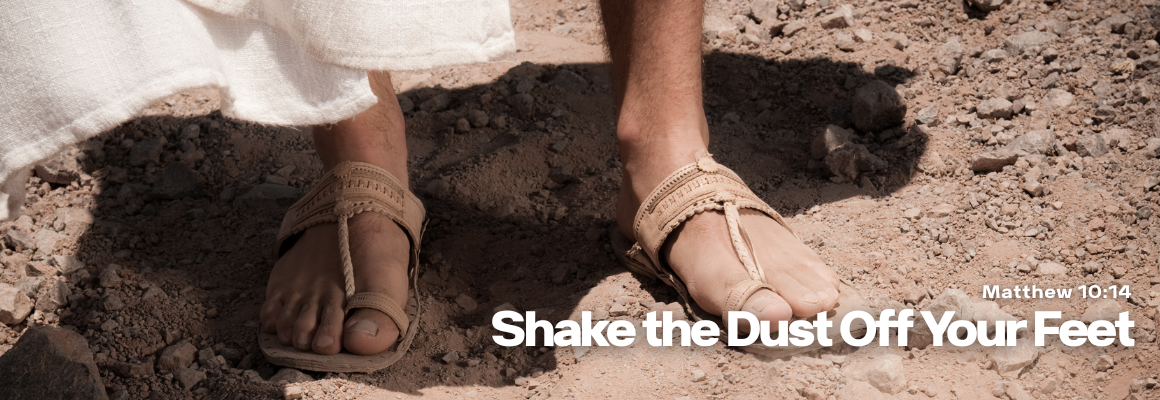
Close-up of two people wearing sandals walking on a dry, dusty path with the title Shake the Dust Off Your Feet displayed at the bottom.
Fundraising Verse of the Week

Shake the Dust Off Your Feet

โ€œIf anyone will not welcome you or listen to your words, leave that home or town and shake the dust off your feetโ€ (Matt. 10:14).

Jesus commissioned the Twelve as the first missionaries to proclaim the message of the Kingdom to the lost sheep of Israel. Their assignment was to โ€œheal the sick, raise the dead, cleanse those who have leprosy, and drive out demonsโ€ (Matt. 10:8). We donโ€™t have the apostolic power to physically raise the dead, but your ministry is changing lives for eternity because the power of the Gospel breaks chains setting people free from their sin. We can learn four important fundraising principles from Jesusโ€™ instructions to his disciples as we identify, cultivate, and solicit donors to partner with us.

Search
How were his disciples supposed to find these generous patrons? Jesus commanded his disciples not to take any money with them for their journey but to seek out โ€œsome worthy personโ€ in whatever town or village they entered. They were learning to trust God to meet their every need. God provides through his people because โ€œthe worker is worth his keepโ€ (Matt. 10:10). Jesus told them not to go to the Gentiles or to the Samaritans. As you search for major donors, focus first on people of faith whose worldview aligns with yours.

Stay
When the disciples found a worthy person, they were to stay in their house until they left the town (see Matt. 10:11). Some fundraisers apply this literally and stay with their major donors. When your donor offers hospitality, itโ€™s a wonderful relationship-building opportunity. The fundraising principle is this: the best way to cultivate major donors is face to face in their homes. It takes time to build trust and develop lasting friendships.

Share
The disciples preached the redemption message to everyone who would listen. As they entered their hostโ€™s home, they shared a greeting and peace (see Matt. 10:11-12). Jesus had taught them many things, so they had many lessons to share and many stories of the wonderful works he had done. โ€œFreely as you have received, freely giveโ€ (Matt. 10:8). You have many transformational stories to share with your prospective donors. Tell them of the all the wonderful things God is doing in the lives of those you are serving.

Shake
If someone wouldnโ€™t welcome a disciple or listen to their words, Jesus instructed them to โ€œleave that home or town and shake the dust off your feetโ€ (Matt. 10:14). We hate to give up on a donor, but if they havenโ€™t responded after youโ€™ve made repeated efforts to share your story, perhaps itโ€™s time to move them to the inactive file and focus on those who are interested. Itโ€™s not your job to convince someone to give to your ministry, itโ€™s only your job to share the message and ask for a gift. The Holy Spirit will prompt those he wants to supply your needs.

Think About This: Jesus sent out his disciples with nothing, but he provided everything they needed through people he had prepared to receive their message. God will provide everything your ministry needs to accomplish his purposes.

Response: Lord, please give me faith to trust you for donors who will meet our needs.

A row of colorful, watercolor-style silhouettes of people raising their hands in celebration. The text on the image reads, โ€œMajor Donor Line Up.โ€
Fundraising Verse of the Week

Major Donor Line Up

Jesse had seven of his sons pass before Samuel, but Samuel said to him, โ€œThe Lord has not chosen these.โ€ 11 So he asked Jesse, โ€œAre these all the sons you have?โ€ โ€œThere is still the youngest,โ€ Jesse answered. โ€œHe is tending the sheepโ€ (1 Samuel 16:10-11).

King Saul disqualified himself, so the Lord sent Samuel to Bethlehem to select the next king. Jesseโ€™s seven sons passed by Samuel, but the Lord rejected each one. At the end of the parade, Samuel asked if there was another. David was taking care of the sheep, so Jesse quickly summoned him. When David arrived, Samuel immediately anointed him as the next king of Israel.

Identifying major donors can take a similar path. We look for external indications of wealthโ€”what they do for a living, where they live, what they drive, etc. However, these clues donโ€™t uncover a donorโ€™s heart. Samuel was impressed with Jesseโ€™s good-looking sons, but the Lord warned him, โ€œDo not consider his appearance or his height, for I have rejected him. The Lord does not look at the things people look at. People look at the outward appearance, but the Lord looks at the heartโ€ (1 Sam. 16:7). What qualities should you identify in a major donor?

Heart
God gave David an amazing descriptor, โ€œI have found David son of Jesse, a man after my own heart; he will do everything I want him to doโ€ (Acts 13:22). Listen carefully to your major donors to discover their passion. Some might have great resources, but they might also have a high appetite for the pleasures of the world. Look for people interested in doing what God wants them to do.

Servant
David was not ashamed to get his hands dirty. Thomas Stanleyโ€™s book, The Millionaire Next Door identifies seven common traits of those who accumulate wealth. Most millionaires arenโ€™t flashy but tend to be business owners who work hard, save money, and live middle-class lifestyles like you and me. When searching for your next major donor, look for the guy who has owned your local hardware store for the last 50 years.

Hand
Major donors are skilled at their work. โ€œAnd David shepherded them with integrity of heart; with skillful hands he led themโ€ (Psa. 78:72). Unbelievers are certainly successful. True success is a gift from the Lord and is connected to generosity. โ€œGive generously to them and do so without a grudging heart; then because of this the Lord your God will bless you in all your work and in everything you put your hand toโ€ (Deut. 15:10).

Spirit
 โ€œFrom that day on the Spirit of the Lord came powerfully upon Davidโ€ (1 Sam. 16:13). David had an impressive resume, โ€œHe is a brave man and a warrior. He speaks well and is a fine-looking man. And the Lord is with him.โ€ (1 Sam. 16:18). Davidโ€™s dependence upon the Spirit set him apart from all the others.

Think About This: David was Israelโ€™s largest major donor. Solomon built the Temple, but David gave generously from his own resources and rallied the Israelites to join him (see 1 Chron. 29:2-9).

Response: Lord, help me look at the hearts of my potential major donors, not their appearance.

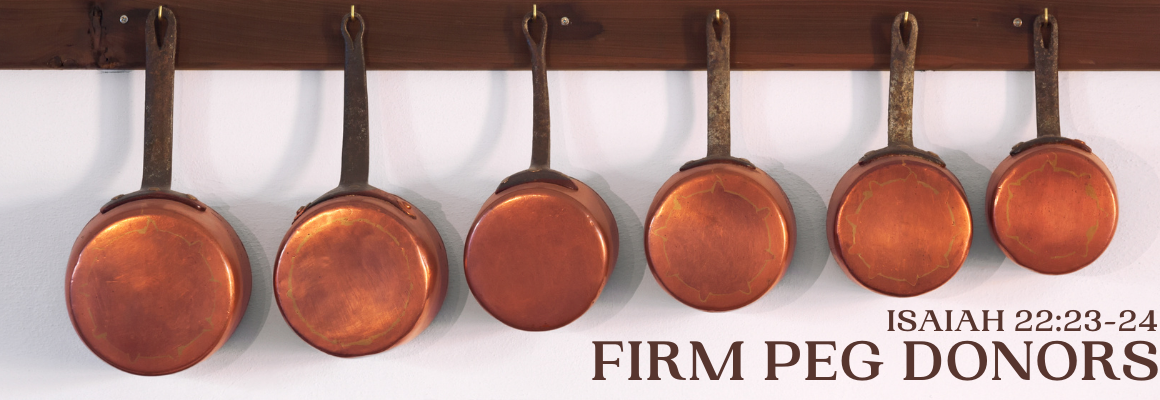
Image of six copper pans hanging neatly on wooden pegs against a white wall, with text overlay reading โ€œFirm Peg Donors Isaiah 22:23-24.โ€
Fundraising Verse of the Week

Firm Peg Donors

โ€œI will drive him like a peg into a firm place; he will become a seat of honor for the house of his father. All the glory of his family will hang on him: its offspring and offshootsโ€”all its lesser vessels, from the bowls to all the jarsโ€ (Isaiah 22:23-24).

Eliakim son of Hilkiah was a servant of King Hezekiah whom the Lord promoted to the throne. Isaiah described Eliakim as a peg driven into a firm place. Householders hung their kitchen utensils on pegs in the wall. Something on its peg was in its proper place ready to be used. This unusual image illustrates the importance of preparing major donors who are firmly in place to support your ministry.

Open/Shut
Isaiah gave Eliakim the keys of David meaning โ€œwhat he opens no one can shut, and what he shuts no one can openโ€ (Isa. 22:22). John used the same description for Jesus Christ (Rev. 3:8). When the Lord opens a door for your ministry, no one can shut itโ€”yet many will try to stand in your way (1 Cor. 16:9). Major donors can help you unlock opportunities that others canโ€™t. Share your passions for what you believe God is prompting you to solve. Help them see how they can lay up treasures in heaven by partnering with you.

Hang On
Firm pegs illustrate security. Eliakim was a strong leader on which Israel could rely. Having trusted major donors by your side gives you confidence to tackle new opportunities. If your key supporters endorse your direction, then you will succeed. Who will stand with you to open your next ministry door? Identify those major donors in a feasibility study as you consider a capital campaign.

Large/Small
Everything was held by a pegโ€”from the large pans and pots to the small bowls and cups. Donโ€™t think that just because youโ€™re not a big ministry major donors wonโ€™t be interested in what you do. Major donors have room for more than one ministry on their giving list. Giving is based on relationships. Concentrate on identifying, cultivating, and soliciting major donors already in your constituency.

Go Away
Eliakim was a โ€œpeg in a firm placeโ€ for a season. Eventually, he was broken off when Judah was finally sent into captivity (Isa. 22:25). Sometimes, when a major donor adopts a ministry, the ministry relies too heavily on that single donor. After more than ten years of giving $600,000 annually to a Christian school, a major donor decided to shift his giving priorities to other interests forcing the school to scramble to make up the lost revenue. Find more than one firm peg to hang onto.

Think About This: Robert Pierpont, from the Fund Raising School at the Indiana University Center on Philanthropy, observes that in a capital campaign the ten largest gifts set the pace for success. If you donโ€™t secure key leadership gifts, you canโ€™t find enough small gifts to fill the gap. Pierpont remarked, โ€œOnce the big-gift-first sequence has been seriously violated, the entire program is in jeopardy.1โ€ Focus your efforts on finding firm peg donors and hang your capital campaign on them.

Response: Father, please bring us key supporters who will partner with us to fulfill your mission.

1Pierpont, R. (2002). Capital Campaigns. Retrieved from The Fundraising School: http://www.philanthropy.iupui.edu/files/course_resources/capital_campaigns_pierpont.pdf

Silhouette of a person fishing from a small boat at sunset, with the sun low over calm ocean waters and a golden reflection across the sea. The text reads: "Vision Casting and Catching โ€“ 2 Samuel 23:15."
Fundraising Verse of the Week

Vision Casting and Catching

David longed for water and said, โ€œOh, that someone would get me a drink of water from the well near the gate of Bethlehem!โ€ (2 Samuel 23:15).

The Philistines were a constant thorn in Davidโ€™s side. To add insult to injury, they set up shop in his hometown, Bethlehem (1 Sam. 16:1). David dreamed of a different future and commented how wonderful it would be to again enjoy a cool drink from the well by the city gate. He didnโ€™t have to say it twice. His three mighty men heard his desire and executed a flawless extraction mission to retrieve a skin of water from behind enemy lines. When they presented the water to David, he realized the risk they took to fulfill his dream and poured it out to the Lord as a drink offering. How can you cast a compelling vision to inspire your ministry partners to action? Consider these four principles.

Leadership
In his book Start with Why, Simon Sinek shares the story of two stonecutters. One hates his job and complains about lifting stones every day in the hot sun. Another replies, โ€œI love my job! Sure, itโ€™s backbreaking work but Iโ€™m building a cathedral!โ€ Why do these two men with the exact same job have opposite perspectives? One caught the vision, one didnโ€™t. David inspired his followers to a higher cause. Are you inspiring your donors to accomplish something that will last beyond their lifetimes?

Relationship
David didnโ€™t release a statement to the press; this was quiet conversation with his close friends. Have you ever had a dream conversation with your close major donors to let them know what God is laying on your heart? Donโ€™t take your ideas to your major donors wrapped up nicely in a bow. Invite your key friends into the conversation while youโ€™re still formulating your ideas. Let them imagine the future with you.

Stewardship
David had proven himself on the battlefield and earned the respect of his followers. Trust is a critical component of leadership and followership. People must believe that you will do what you say you will do. Leadership is influencing others. As Spider-Man learned, โ€œWith great power comes great responsibility.โ€ As a leader you have great influence over your donorsโ€™ giving priorities. Make sure your vision is worthy of their sacrificial giving.

Worship
These men risked their lives to bless David with a remarkable gift. The only thing David could do was to reflect the glory back to God. This is exactly how we should respond when people give sacrificially. โ€œBecause of the service by which you have proved yourselves, others will praise God for the obedience that accompanies your confession of the gospel of Christ, and for your generosity in sharing with them and with everyone elseโ€ (2 Cor. 9:13).

Think About This: John Quincy Adams said, โ€œIf your actions inspire others to dream more, learn more, do more and become more, you are a leader.โ€ Inspire your donors to dream more, learn more about Godโ€™s vision for your ministry, give more, and become a vital part of your future.

Response: Lord, please help me understand your vision for what you want us to accomplish. Help me share it effectively with my ministry partners.

A male and female lion resting together on dry grass in a woodland setting, with the words 'Asking King and Queen โ€“ Nehemiah 2:6' displayed on the right side of the image.
Fundraising Verse of the Week

Asking King and Queen

Then the king, with the queen sitting beside him, asked me, โ€œHow long will your journey take, and when will you get back?โ€ It pleased the king to send me; so I set a time (Nehemiah 2:6).

Nehemiah heard of Jerusalemโ€™s desperate situation; the city walls had been destroyed and the people were living in constant danger (Neh. 1:1-3). He wept, prayed, and planned for four months about how to solve this problem. One day as he was serving as cupbearer, the king noticed Nehemiahโ€™s sadness and asked what was wrong. This was Nehemiahโ€™s major donor momentโ€”he shared his burden and asked the king for (a) passports, (b) royal timber, and (c) time off. This verse adds an interesting dynamic, the queen was sitting beside the king and heard every word. The fundraising application is clear: as often as possible, you should include husband and wife when you ask for a gift.

Emotional
Generally, women tend to be more emotionally expressive than men. Thatโ€™s important to remember because what your ministry does to serve people should have an emotional element. Nehemiah himself was moved to tears for the people living in Jerusalem (Neh. 1:4). He was motivated to act because of the critical needs of hurting people. Include both husband and wife as you share your stories of changed lives. Men might make an intellectual giving decision; women are more concerned with issues of the heart.

Relational
Itโ€™s interesting that the queen is mentioned in the context of the kingโ€™s question, โ€œHow long will it take and when are you coming back?โ€ It seems that the king and queen liked having Nehemiah around and were going to miss him when he was gone. The cupbearer wasnโ€™t just an ordinary slave, he was the kingโ€™s confidant. As official taste-tester, he had sipped multiple glasses of wine to ensure that the king and queen were not poisoned. In your donor development work, make personal friends with both the husband and wife.

Intuition
One great reason for meeting with husband and wife is to tap into a womanโ€™s intuition. Women possess a knack for knowing what others are feeling and thinking. Jon Voight observes, โ€œThere’s something real in women’s intuition. It’s an accurate signpost for decision making, but it usually bumps up against man’s logic. So, we have to put ego aside and listen to them.โ€ Include wives in your solicitation conversations, perhaps one will share some insights that will improve your project.

Life Span
Actuarial tables calculate the average life expectancy for women is 79 years and 72 years for men. Perhaps youโ€™ve seen a funny meme of why women live longer than men that usually includes electricity, water, ladders, and other risky, non-OSHA approved activities. You should cultivate wives as major donors, because statistically they will be making giving decisions years after their husbands have passed on to Glory.

Think About This: An administrator pitched a husband and wife on a clock tower project. The husbandโ€™s first reaction was, โ€œI donโ€™t think we are interested in this.โ€ His wife responded, โ€œI think itโ€™s a great idea!โ€ To which the husband continued, โ€œI think weโ€™re interested in this.โ€

Response: Lord, please give me insight to include husbands and wives in our giving opportunities.

Wooden gate surrounded by lush greenery and blooming white flowers, with the words โ€œGetting Past the Gatekeeperโ€ and 2 Chronicles 23:19 written in white text.
Fundraising Verse of the Week

Getting Past the Gatekeeper

โ€œHe also stationed gatekeepers at the gates of the Lordโ€™s temple so that no one who was in any way unclean might enterโ€ (2 Chronicles 23:19).

Gatekeepers have one jobโ€”to keep out unwanted visitors. Perhaps you have encountered a major donor gatekeeper in the form of a financial planner, attorney, family member, or personal assistant. How do you get around the gatekeeper to connect with your donors? Gatekeepers process boxes of correspondence for major donors and must determine what is important and unimportant. Just imagine sorting through ten times the mail you receive daily. One ministry leader was surprised to learn that his notes werenโ€™t getting to his major donor friends and then discovered the gatekeeperโ€™s unwritten rules about whether he would pitch the correspondence or pass it on to the donor. Here is one gatekeeperโ€™s pitch/pass list:

Thank you note on the receipt. Pitch It!
A common practice for ministry leaders is to write a personal thank you to the donor on the gift receipt. Itโ€™s a nice gesture that probably gets noticed by 95% of your donors. However, a note on a receipt is still a receipt, not an official thank you note.

Any mention of a future project. Pitch It!
Itโ€™s tempting to tease a new project while you thank your donor for their gift to your current project. But if you focus on the next big thing, are you expressing gratefulness for the gifts that got you this far? Effective thank you notes must be genuine. Donโ€™t just check the box saying that you thanked your donor.

Handwritten thank you note that mentions a future gift. Pitch it!
Congratulations for sending a handwritten note! Handwritten notes are rare. Donโ€™t dilute your thank you by asking your ministry partner to consider a future gift. Your thank you note should focus on your donor not you.

Printed thank you note. Pitch It!
Some fundraisers have lousy handwriting and use a computer to print a note. Printed notes feel impersonal because they are. The only exception is if your donor knows that you have a health condition that makes handwriting difficult for you.

Personal, handwritten, stand-alone thank you note. Pass to the donor!
Hereโ€™s what passes this gatekeeperโ€™s scrutiny: a handwritten thank you note thatโ€™s just a thank you note. Period. Mike was having difficulty connecting with a major donor. The donor had given but never responded to Mikeโ€™s phone calls or emails. Mike decided to be proactive and personally deliver his handwritten thank you note. He was interrogated at the front entrance, but the gatekeeper called the donor and said, โ€œMike, from ABC Ministries is here with a thank you note. Should I send him up?โ€ The answer came back, โ€œSure.โ€ The major donor was glad to see him and invited him in.

Think About This: Jesus taught about the relationship between the shepherd, his sheep, and the gatekeeper. โ€œThe gatekeeper opens the gate for him, and the sheep listen to his voice. He calls his own sheep by name and leads them outโ€ (John 10:3). When you have a personal relationship with your donor, the gatekeeper will open the door wide.

Response: Father, please open the gate and help me connect with my major donors.

Close-up of a sturdy brass padlock securing a bright blue metal door. Text overlay reads 'The Major Gift Lockpicking Tool,' suggesting a metaphor for unlocking opportunities. Simple, bold design with a focus on the lock.
Fundraising Verse of the Week

The Major Gift Lockpicking Tool

โ€œA gift opens the way to the giver and ushers the giver into the presence of the greatโ€ (Proverbs 18:16).

The Lockpicking Lawyer, a YouTube content creator who opens “unpickable” locks, received an interesting challenge. A viewer, whose local locksmith had resorted to using an angle grinder to open a lock, sparked a heated debate. The viewer insisted the Lockpicking Lawyer could have picked it, while the locksmith dismissed his videos as fake. The challenge was set: if the Lockpicking Lawyer could pick the lock faster than the time it took to cut it with an angle grinder, the locksmith would refund the viewer $75. While the angle grinder took two minutes and fourteen seconds, the Lockpicking Lawyer needed only 28 seconds to pick the lock.

One frustrating reality for every fundraiser is the inability to open a major donor door. Every attempt to reach a prospect feels more difficult than breaking into Fort Knox. Solomon reveals the key to connecting with any major donor prospect is to offer a gift.

A Personal Gift
Who doesnโ€™t like to receive a gift? When choosing a gift, donโ€™t default to SWAG (Stuff We All Get) you hand out at a conference. Get more creative than pens emblazoned with your logo. Consider your prospectโ€™s interests. What unique gift would your potential donor appreciate that reminds them of your ministry whenever they see it? Perhaps you could share something special from one of your noteworthy alumni.

An Opportunity Gift
Pay attention to your prospective donor’s unique interests and expertise, then create opportunities for them to share their knowledge. Business professionals might appreciate invitations to lead workshops, teach classes, or deliver keynote speeches. A prospective donor with a passion for Revolutionary War history brings history to life in full George Washington attire. A perceptive school principal invites him to captivate elementary students with his presentations. For this donor, the opportunity to share his enthusiasm for history is itself a meaningful gift.

An Honor Gift
Pay attention and acknowledge news about your prospective donor. It could be as simple as sending a note of congratulations about their business success, job promotion, or personal accomplishment like a hole-in-one or being featured in the media. One college invites their prospective donors to a banquet in their honor and presents them with an award acknowledging their contributions to the community.

The Gift of Prayer
One simple way to make a meaningful connection is to offer to pray for your prospective donors. You may never have met that person but offering to pray may open a door for a future conversation. Perhaps they or a family member have experienced a personal tragedy and your offer to pray brings comfort and encouragement. Perhaps theyโ€™ve experienced great success and your prayers will remind them to give glory to God. The key is connecting with them spiritually.

Think About This: The greatest gift you could ever give your prospective donor is the gift of the Good News. Perhaps you could share a book, music, or video from your ministry that includes a gospel presentation.

Response: Father, please give me wisdom to choose the best gift that will open major donor doors. Thank you for sharing the greatest gift, your Son, Jesus Christ.

An image featuring a barren, cracked desert landscape under a clear blue sky. The text on the image reads, "Beware of the boasting donor" in large, bold lettering, with "Proverbs 25:14" written below in smaller text. The design conveys a cautionary and reflective
Fundraising Verse of the Week

Beware of the Boasting Donor

โ€œLike clouds and wind without rain is one who boasts of gifts never givenโ€ (Proverbs 25:14).

Occasionally, you meet a major donor who checks all your qualifying boxes. They have a link to your organization. They are interested in your projects and they seem to have the ability and willingness to give. They even talk about how much they love your ministryโ€”yet they never give. Solomon illustrates this person as โ€œa cloud without rain.โ€ This prospect gives you hope for a refreshing gift but never delivers. Texans describe this person as, โ€œAll hat but no cattle.โ€ This potential donor is full of big talk but lacks action. Unfortunately, he or she is a pretender.

How can you identify and avoid this non-giver? Following Solomon’s warning about boastful behavior, James describes four distinct ways pride manifests itself in people’s speech (James 4:13-16).

Success
โ€œNow listen, you who say, โ€˜Today or tomorrow we will go to this or that city, spend a year there, carry on business and make moneyโ€™โ€ (James 4:13). Boasters have big ideas and big plans. They think they control their calendars, travels, businesses, and profits but they fail to realize that they donโ€™t control anything. The Lord blesses a person with โ€œthe ability to produce wealthโ€ (Deut. 8:18).

Strength
Arrogant people think they will live forever. โ€œWhy, you do not even know what will happen tomorrow. What is your life? You are a mist that appears for a little while and then vanishesโ€ (James 4:14). The rich farmer decided to build bigger barns to store his surplus grain. Giving some of his bounty to others didnโ€™t even cross his mind. Little did he realize that his life would be demanded from him that night (Luke 12:17-20). โ€œThen who will get what you have prepared for yourself?โ€ (Luke 12:20).

Self
โ€œInstead, you ought to say, โ€œIf it is the Lordโ€™s will, we will live and do this or thatโ€ (James 4:15). People who are filled with pride donโ€™t have room in their vocabulary for God or his will. They are too focused on their plans and never ask the Lord what he would have them do. Jesus himself said, โ€œIt is more blessed to give than to receiveโ€ (Acts 20:35).

Schemes
โ€œAs it is, you boast in your arrogant schemes. All such boasting is evilโ€ (James 4:16). Jim was a very successful entrepreneur who talked of giving โ€œbig.โ€ He was always chasing the next deal and needed all his cash to make it happen. He made several promises to give even more when the next deal closed but he never gave. Paul taught, โ€œFor if the willingness is there, the gift is acceptable according to what one has, not according to what one does not haveโ€ (2 Cor. 8:12).

Think About This: James makes a sobering conclusion, โ€œIf anyone, then, knows the good they ought to do and doesnโ€™t do it, it is sin for themโ€ (James 4:17). The person who boasts of a gift never given is sinning.

Response: Lord, please give me insight to hear if my donorโ€™s heart is focused on your will or their own. Give me wisdom to challenge this type of donor in truth and love about their gift commitment.

An image featuring a majestic eagle in flight against a vibrant sunrise or sunset sky, symbolizing strength and guidance. The text overlay reads "TRAINING YOUR TEAM TO ASK" in bold, elegant font, with "Deuteronomy 32:11" below it, emphasizing the theme of leadership and nurturing development.
Fundraising Verse of the Week

Training Your Team to Ask

โ€œLike an eagle that stirs up its nest
and hovers over its young,
that spreads its wings to catch them
and carries them aloftโ€ (Deuteronomy 32:11).

Mother eagles have a fascinating method for teaching their offspring to fly. Around 8-11 weeks after the eaglets hatch, she tears up their cozy nest to force her juveniles out of bed. She then flutters over them to show them what to do. The young eagles venture out to the ends of the branches and begin flapping their wings. Finally, they take a leap of faith but when their unsteady wings cause them to fall, their attentive mother will dart underneath at the last moment to save them from a crash landing. Before they can catch their breath, she flies them higher for a second attempt. Eventually, the fledgling gets the hang of it and will spend the next 35 years soaring through life. Her example teaches us four lessons about training new fundraisers.

Stirs up its nest
Some fundraisers spend a lot of time in their cozy offices. Certainly, there are lots of things to do in your office. You have reports to run, brochures to design, donors to research, and important meetings to attend but major donor fundraising happens face to face with your ministry partners. If you are the leader, stir up your team and kick them out of the nest.

Hovers over its young
The mother eagle demonstrates to her young how to fly. The wise executive leads by example. Donโ€™t be like the Pharisees, who โ€œload people down with burdens they can hardly carry, and you yourselves will not lift one finger to help themโ€ (Luke 11:46). As the president or executive director of your ministry, you should be a player-coach when it comes to raising money.

Spreads its wings to catch them
Making your first ask can be traumatic for a rookie asker. Donโ€™t send your inexperienced fundraiser to a major donor meeting by themselves. Jesus sent out his disciples in pairs. One could talk while the other one prayed. As the experienced fundraiser, you can swoop in and save the conversation by answering a difficult question, explaining your ministryโ€™s position on a key issue, or making the ask crystal clear.

Carries them aloft
Not every major donor meeting ends with a โ€œyes;โ€ sometimes you fall flat on your face. Fundraising is a journey, not a destination. Martin Luther King Jr. said, โ€œif you can’t fly then run, if you can’t run then walk, if you can’t walk then crawl, but whatever you do you have to keep moving forward.โ€ Donโ€™t allow your team to give up. Give them another opportunity to ask and eventually, they will succeed.

Think About This: What if youโ€™re the experienced fundraiser and your boss is not? Learn how to lead up. Show them by your example how to ask. Set them up for success by inviting them on donor calls and giving them an easy first ask. Build their confidence and pray that God will give them a love for the ministry of fundraising.

Response: Father, give me wisdom to teach others what youโ€™ve taught me about asking. Please give our team new strength to soar high โ€œon wings like eaglesโ€ (Isa. 40:31).

Fundraising Verse of the Week

Opinionated Major Donors

But Naaman went away angry and said, โ€œI thought that he would surely come out to me and stand and call on the name of the Lord his God, wave his hand over the spot and cure me of my leprosy.โ€ (2 Kings 5:11)

As commander of the army of the King of Aram, Naaman was a proud man and by human standards he had every reason to be. โ€œHe was a great man in the sight of his master and highly-regardedโ€ (2 Kings 5:1). He was rich, famous, and accustomed to telling people what to do. Only one thing held him backโ€”he had leprosy. A servant girl he had captured told his wife Elisha would heal him. So, he made a pilgrimage to see the prophet.

When Naamanโ€™s entourage arrived. Elisha didnโ€™t even come to the door but sent his servant to instruct Naaman to go wash in the Jordan seven times and be healed. Naaman stomped off in a huff and told his servant Elisha should have at least come out to meet him, pray to his God, wave his hands over the leprosy, and cure him. He was convinced he knew more than Elisha about how to heal his leprosy.

Major Opinion
Naamanโ€™s attitude toward Elishaโ€™s instructions is like some major donors who think you are doing ministry all wrong. No doubt youโ€™ve listened patiently to someone who doesnโ€™t understand why you did or did not do something a certain way. You should be eager to listen, learn, and respond, but donโ€™t change something just because a wealthy donor says you should. Stay on mission.

Major Change
A courageous servant spoke truth and changed Naamanโ€™s mind. He went to the Jordon, washed seven times, and was healed physically and spiritually. It may not happen often but occasionally a major donor who has opposed you, may come to their senses, see things differently, and apologize. (see 2 Tim. 2:24-26).

Major Gift
Naaman rushed back to Elisha and offered him extravagant gifts of gold, silver, and clothing. But Elisha did something most ministry leaders would never considerโ€”he refused his gifts. In contrast to false teachers who use religion for financial gain, Elisha wanted Naaman to understand the free gift of salvation. Are you more concerned about a gift or your prospective donorโ€™s spiritual health?

Major Lesson
Naaman asked permission to take some dirt home so he could sacrifice burnt offerings to the Lord. Then he asked if God would forgive him for accompanying his king to the pagan temple as part of his job. Elisha granted both requests told him to go in peace. Elisha showed grace and kindness to this new believer because he knew spiritual growth takes time.

Think About This: Some donors may be tempted to influence your decisions by wielding their checkbooks. Itโ€™s easier to refuse a gift when it comes with strings that might pull you off mission. Donโ€™t sacrifice your core values for a short-term gain. Stand for biblical truth. God will bring you like-minded partners who will appreciate your courage.

Response: Father, please help me care more about my donorโ€™s relationship to you than anything else. Please give me discernment to know when I should refuse a gift.


Ron Haas has served the Lord as a pastor, the vice president of advancement of a Bible college, a Christian foundation director, a board member and a fundraising consultant. Heโ€™s authored three books: Ask for a Fish โ€“ Bold Faith-Based Fundraising, Simply Share โ€“ Bold, Grace-Based Giving, and Keep on Asking โ€“ Bold, Spirit-Led Fundraising. He regularly presents fundraising

1 2
Cart Overview