


0
0
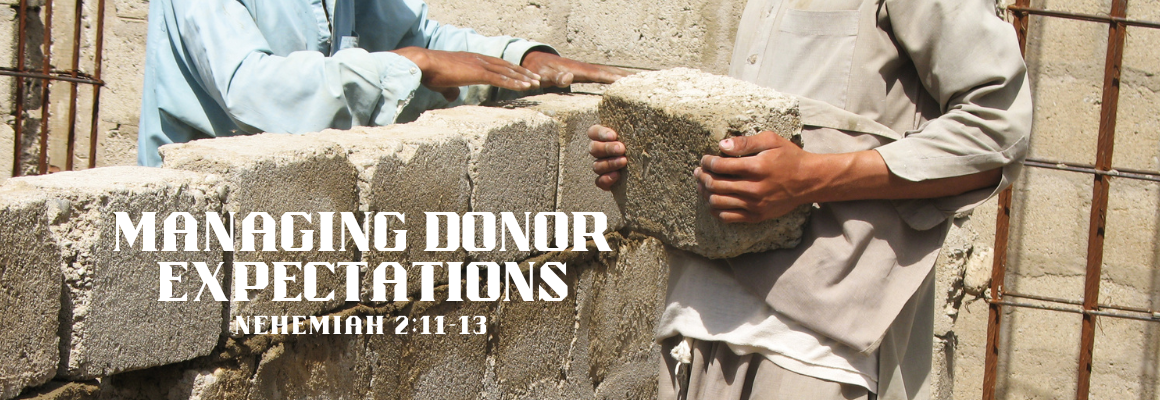
Two workers building a stone wall, each holding large concrete blocks, with the title Managing Donor Expectations overlaid on the image.
Fundraising Verse of the Week

Managing Donor Expectations

“I went to Jerusalem, and after staying there three days I set out during the night with a few others. I had not told anyone what my God had put in my heart to do for Jerusalem” (Nehemiah 2:11-12).

Nehemiah was on a mission from God to rebuild the walls of Jerusalem. He asked King Artaxerxes for help and the king miraculously gave him time off, safe passage, and timber to make beams for the gates. He even sent along army officers and cavalry (see Neh. 2:7-9). Nehemiah could have marched into Jerusalem with pomp and circumstance; instead, he arrived unassumingly. We can learn much from Nehemiah about communicating vision and creating buy-in.

Listen
Leaders have many voices vying for their attention, especially when it comes to fundraising. Everybody has an agenda and wants to fund their pet project. It’s easy for leaders to become people-pleasers and attempt to make everyone happy, but the most important voice to hear is God’s. Nehemiah was keenly aware of what God called him to do and he wasn’t going to let anything, or anyone stand in his way. What is God telling you to accomplish for his glory?

Learn
After three days in Jerusalem, Nehemiah decided to inspect the walls for himself. He didn’t tell “the Jews or the priests or nobles or officials or any others who would be doing the work” (Neh. 2:16). Instead, he took a few confidants on a night vision tour around the wall. Nehemiah was careful not to raise expectations before he had a clear understanding of what needed to be accomplished. Don’t cast a vision before you have a solid plan to carry it out.

Lead
When Nehemiah finished his due diligence, he preached a three-point sermon: (1) We have a serious problem, (2) God has already provided our answer, (3) Now is our time to respond (see Neh. 2:17). Share this same appeal with your donors—the problem, your solution, God’s provision, and a call to action. Perhaps Nehemiah sounded something like William Wallace’s rousing speech in Braveheart, “they’ll never take our freedom!” His pep talk worked because all the people replied, “Let’s start rebuilding” (Neh. 2:18).

Look Out
When you take a stand for the Lord, your enemies will spring into action. Sanballat, Tobiah, and Geshem were quick to mock and ridicule Nehemiah and the people. As an anonymous WWII bomber pilot said, “The flak only gets heavy when you’re over the target.” Nehemiah didn’t let criticism paralyze him. “The God of heaven will give us success. We his servants will start rebuilding, but as for you, you have no share in Jerusalem or any claim or historic right to it” (Neh. 2:20).

Think About This: Creating buy-in is ultimately about influencing others, not making demands on them. Nehemiah invited the people to join him in the work, “Come, let us rebuild the wall of Jerusalem, and we will no longer be in disgrace” (Neh. 2:17). Don’t demand a gift from your donors, invite them to partner with you in the great work God has called you to accomplish.

Response: Lord, help me listen to your voice so I can inspire our donors to accomplish the tasks you’ve marked out for us (see Heb. 12:1).

A male and female lion resting together on dry grass in a woodland setting, with the words 'Asking King and Queen – Nehemiah 2:6' displayed on the right side of the image.
Fundraising Verse of the Week

Asking King and Queen

Then the king, with the queen sitting beside him, asked me, “How long will your journey take, and when will you get back?” It pleased the king to send me; so I set a time (Nehemiah 2:6).

Nehemiah heard of Jerusalem’s desperate situation; the city walls had been destroyed and the people were living in constant danger (Neh. 1:1-3). He wept, prayed, and planned for four months about how to solve this problem. One day as he was serving as cupbearer, the king noticed Nehemiah’s sadness and asked what was wrong. This was Nehemiah’s major donor moment—he shared his burden and asked the king for (a) passports, (b) royal timber, and (c) time off. This verse adds an interesting dynamic, the queen was sitting beside the king and heard every word. The fundraising application is clear: as often as possible, you should include husband and wife when you ask for a gift.

Emotional
Generally, women tend to be more emotionally expressive than men. That’s important to remember because what your ministry does to serve people should have an emotional element. Nehemiah himself was moved to tears for the people living in Jerusalem (Neh. 1:4). He was motivated to act because of the critical needs of hurting people. Include both husband and wife as you share your stories of changed lives. Men might make an intellectual giving decision; women are more concerned with issues of the heart.

Relational
It’s interesting that the queen is mentioned in the context of the king’s question, “How long will it take and when are you coming back?” It seems that the king and queen liked having Nehemiah around and were going to miss him when he was gone. The cupbearer wasn’t just an ordinary slave, he was the king’s confidant. As official taste-tester, he had sipped multiple glasses of wine to ensure that the king and queen were not poisoned. In your donor development work, make personal friends with both the husband and wife.

Intuition
One great reason for meeting with husband and wife is to tap into a woman’s intuition. Women possess a knack for knowing what others are feeling and thinking. Jon Voight observes, “There’s something real in women’s intuition. It’s an accurate signpost for decision making, but it usually bumps up against man’s logic. So, we have to put ego aside and listen to them.” Include wives in your solicitation conversations, perhaps one will share some insights that will improve your project.

Life Span
Actuarial tables calculate the average life expectancy for women is 79 years and 72 years for men. Perhaps you’ve seen a funny meme of why women live longer than men that usually includes electricity, water, ladders, and other risky, non-OSHA approved activities. You should cultivate wives as major donors, because statistically they will be making giving decisions years after their husbands have passed on to Glory.

Think About This: An administrator pitched a husband and wife on a clock tower project. The husband’s first reaction was, “I don’t think we are interested in this.” His wife responded, “I think it’s a great idea!” To which the husband continued, “I think we’re interested in this.”

Response: Lord, please give me insight to include husbands and wives in our giving opportunities.

Cart Overview