
0
0
A gleaming ornate sword against a black background with the text Be This Kind of Fundraiser and the scripture reference 2 Samuel 23:9-10 in white lettering.
Fundraising Verse of the Week

Be This Kind of Fundraisers

“Next to him was Eleazar… As one of the three mighty warriors, he was with David when they taunted the Philistines gathered at Pas Dammim for battle. Then the Israelites retreated, but Eleazar stood his ground and struck down the Philistines till his hand grew tired and froze to the sword. The Lord brought about a great victory that day. The troops returned to Eleazar, but only to strip the dead.” (2 Samuel 23:9-10).

What makes a great fundraiser? It’s someone who finishes what they start. The person who stays until the last guest leaves the gala. The gift officer who keeps making calls even when no one picks up. The one who keeps building relationships when donors seem uninterested, and keeps asking for gifts long after everyone else has given up. This kind of fundraiser is rare. Eleazar shows us what a tenacious fundraiser looks like, the person who keeps going when everyone else quits. Here are four things we can learn from him.

Don’t Run Away
There’s something almost funny about this story. The Israelites trash-talked the Philistines (think of that famous scene in Braveheart), got them all riled up, and then ran away. Sound familiar? It’s like when your board gets excited about a big campaign but disappears when the work gets hard. As one board member joked, “We’re behind you…way, way behind you.” But Eleazar didn’t care. He stayed focused and refused to run.

Keep Going When You’re Exhausted
Picture Eleazar fighting wave after wave of enemies until he’s completely worn out. That’s fundraising, right? You’ve got events to plan, mailings to send, reports to write, and then there’s the actual work of finding donors, building relationships, and asking for money. There’s never enough hours in the week. When you feel like this, remember: “I am weary, God, but I can prevail” (Proverbs 30:1).

Hold Tight to God’s Promises
Here’s the amazing part—Eleazar fought so long and so hard that his hand literally froze to his sword. He couldn’t let go even if he wanted to. That’s how you need to grip God’s Word in your fundraising work. You’ll face conversations and situations you can’t handle in your own understanding. You need God’s wisdom and strength daily. “But as for you, be strong and do not give up, for your work will be rewarded” (2 Chronicles 15:7).

Let God Do His Part
The passage says, “The Lord brought about a great victory that day.” Yes, Eleazar did something incredible, but God made it possible. You might be the most talented fundraiser around, but your success ultimately comes from God’s strength and blessing. You can do your part, make the calls, write the emails, build the relationships, make the ask. But only God can move people’s hearts to give.

Think About This: When the battle ended, everyone came back, but only to collect the valuables from the dead enemies. All the hard work was already done. Here’s the question: Are you the one doing the heavy lifting, or are you just showing up after someone else has done the work?

Response: Lord, give me the strength to keep asking when everyone else runs away. Help me be a mighty fundraiser for your glory!

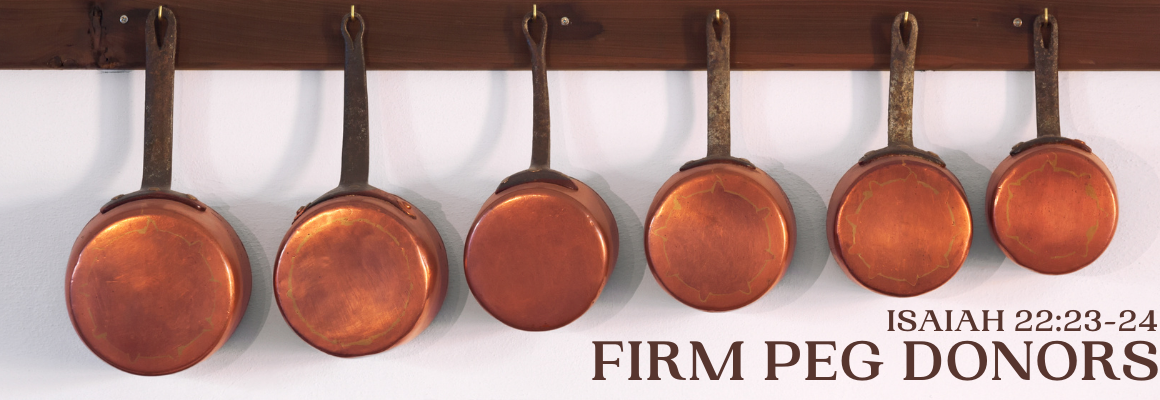
Image of six copper pans hanging neatly on wooden pegs against a white wall, with text overlay reading “Firm Peg Donors Isaiah 22:23-24.”
Fundraising Verse of the Week

Firm Peg Donors

“I will drive him like a peg into a firm place; he will become a seat of honor for the house of his father. All the glory of his family will hang on him: its offspring and offshoots—all its lesser vessels, from the bowls to all the jars” (Isaiah 22:23-24).

Eliakim son of Hilkiah was a servant of King Hezekiah whom the Lord promoted to the throne. Isaiah described Eliakim as a peg driven into a firm place. Householders hung their kitchen utensils on pegs in the wall. Something on its peg was in its proper place ready to be used. This unusual image illustrates the importance of preparing major donors who are firmly in place to support your ministry.

Open/Shut
Isaiah gave Eliakim the keys of David meaning “what he opens no one can shut, and what he shuts no one can open” (Isa. 22:22). John used the same description for Jesus Christ (Rev. 3:8). When the Lord opens a door for your ministry, no one can shut it—yet many will try to stand in your way (1 Cor. 16:9). Major donors can help you unlock opportunities that others can’t. Share your passions for what you believe God is prompting you to solve. Help them see how they can lay up treasures in heaven by partnering with you.

Hang On
Firm pegs illustrate security. Eliakim was a strong leader on which Israel could rely. Having trusted major donors by your side gives you confidence to tackle new opportunities. If your key supporters endorse your direction, then you will succeed. Who will stand with you to open your next ministry door? Identify those major donors in a feasibility study as you consider a capital campaign.

Large/Small
Everything was held by a peg—from the large pans and pots to the small bowls and cups. Don’t think that just because you’re not a big ministry major donors won’t be interested in what you do. Major donors have room for more than one ministry on their giving list. Giving is based on relationships. Concentrate on identifying, cultivating, and soliciting major donors already in your constituency.

Go Away
Eliakim was a “peg in a firm place” for a season. Eventually, he was broken off when Judah was finally sent into captivity (Isa. 22:25). Sometimes, when a major donor adopts a ministry, the ministry relies too heavily on that single donor. After more than ten years of giving $600,000 annually to a Christian school, a major donor decided to shift his giving priorities to other interests forcing the school to scramble to make up the lost revenue. Find more than one firm peg to hang onto.

Think About This: Robert Pierpont, from the Fund Raising School at the Indiana University Center on Philanthropy, observes that in a capital campaign the ten largest gifts set the pace for success. If you don’t secure key leadership gifts, you can’t find enough small gifts to fill the gap. Pierpont remarked, “Once the big-gift-first sequence has been seriously violated, the entire program is in jeopardy.1” Focus your efforts on finding firm peg donors and hang your capital campaign on them.

Response: Father, please bring us key supporters who will partner with us to fulfill your mission.

1Pierpont, R. (2002). Capital Campaigns. Retrieved from The Fundraising School: http://www.philanthropy.iupui.edu/files/course_resources/capital_campaigns_pierpont.pdf

Capital Campaigns, Donor Relations, Fundraising, Major Donors

When The Donor Isn’t Ready

How do you know when the donor isn’t ready? If you’ve been involved in development work for long, you’ve probably had a situation where you made the “ask” of a donor before they’re weren’t ready. How so? A couple of differing ways, probably – either they were offended, said “no”, or gave a significantly smaller amount than you hoped for. No worries, we have all been there a time or two.

Maybe a better question is – how can you know (for next time)? The relationship between a donor, the development staff person or volunteer assigned to the donor, and the institution in need of support is a tricky one. There are guidelines of when a donor is ultimately “ready” for solicitation, but no hard, fast rules. Every donor, every organization, and every campaign is different.

Capital Campaigns, Major Donors, Stewardship

A Pleasant Million Dollar Surprise

Recently, I was privileged to conduct Pre-Campaign Study interviews on behalf of a client. Essentially, these interviews are one-on-one meetings with their key stakeholders. This capital campaign would be the single largest fundraising effort ever entered into by this organization – the total needs exceeding $5 million. When we conduct these interviews, we ask the stakeholders several questions to gather their perception of the need. These are confidential conversations. We end each interview by asking if they would consider supporting the campaign as described and to estimate what their three-year giving level might look like. These are not pledge commitments, but they do help us to evaluate what the total dollars might project to.

Cart Overview