
0
0
quotation marks Nighttime city skyline with glowing lights stretching across the horizon, overlaid with the text Worried About Many Fundraising Things and a scripture reference, conveying busyness and overwhelm in fundraising.
Fundraising Verse of the Week

Worried About Many Fundraising Things

“Martha, Martha,” the Lord answered, “you are worried and upset about many things,  but few things are needed—or indeed only one. Mary has chosen what is better, and it will not be taken away from her” (Luke 10:41-42).

Martha had a servant’s heart and wanted everything to be perfect for Jesus. No doubt her meal was a lovely Jewish feast with a fish course, soup, a main course of meat or poultry, followed by dessert. Naturally, there were more tasks to complete than time to do them. Luke records, “Martha was distracted by all the preparations that had to be made” (vs. 40).  So, Martha asked Jesus to tell Mary to help her prepare. Jesus gently rebuked her and reminded her to focus on what mattered most—cultivating a relationship with him.

Fundraisers also face the distraction of many competing priorities. Each task seems important, but you must prioritize among many good things to focus on the most important—cultivating relationships with your key donors.

Many things
What are your “many fundraising things”? Fundraisers live in an intense, fast-paced environment juggling multiple tasks simultaneously—coordinating volunteers, managing donor communications, overseeing events, and tracking financial goals. The constant pressure to meet deadlines, respond to donor inquiries, and adapt to unexpected challenges creates a whirlwind of activity that demands your every waking moment.

Few Things
Martha was worried and upset about many things, but Jesus said only a few things were needed. It’s easy to fall into the fundraising trap of “just one more event.” Before agreeing to the next ice bucket challenge, ask yourself: Does this event deepen my relationships with donors, or is it simply another activity without fundraising focus or return on investment? It’s much better to do a few things well than many things haphazardly. More activities don’t necessarily mean greater productivity.

Better Things
Fundraising is a constant struggle between making things complex or keeping them simple. Sometimes we confuse our donors when we try to do too many things at once—running multiple campaigns and sending mixed messages. If you can’t clearly communicate your campaign story in sixty seconds, it’s too complicated. The best fundraisers keep their message concise by telling one clear story and making it easy for people to understand your mission and how they can partner with you.

One Thing
John 12:2 records the second time Martha hosted Jesus, “Here a dinner was given in Jesus’ honor. Martha served, while Lazarus was among those reclining at the table with him.” Martha again served but this time she was not distracted with busyness. She had learned to cherish spending time with Jesus. The highest and best use of your fundraising time this week is investing quality time in cultivating relationships with your key donors. Everything else should take second place.

Think About This: If you’re going to conduct an orchestra, you must turn your back on the crowd. Likewise, if you prioritize cultivating donor relationships, you must say no to many good but distracting fundraising activities. Martha finally chose wisely. Will you?

Response: Lord, please remove the clutter from my calendar and schedule some divine appointments. Prompt me with the name of one key donor you want me to contact this week.

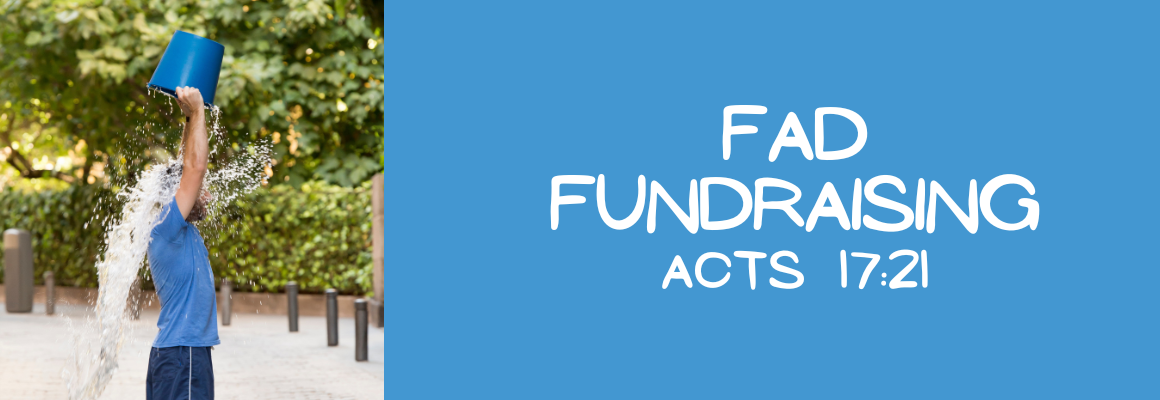
Person participating in an ice bucket challenge, dumping a bucket of water over their head outdoors, with the words 'Fad Fundraising' and 'Acts 17:21' on a blue background.
Fundraising Verse of the Week

Fad Fundraising

“All the Athenians and the foreigners who lived there spent their time doing nothing but talking about and listening to the latest ideas” (Acts 17:21).

Joseph Bayly wrote The Gospel Blimp as a satire to poke fun at Christian ministries that build elaborate systems but neglect the real work of evangelism. The plot focuses on George and Ethel, a friendly Christian couple who was concerned about their next-door neighbors but didn’t know how to share the good news of Jesus Christ. One night during a gathering at their home with some Christian friends, a blimp flew overhead. Their friend Herm came up with a brilliant idea: Why not use a blimp to proclaim the Christian message to the unchurched citizens of Middletown? Herm’s vision spawned a new non-profit organization with an exciting new strategy to buy a used blimp, hire a pilot, and evangelize their hometown by towing Bible-verse banners, broadcasting Christian music and programs over loudspeakers, and “carpet bombing” folks with gospel tracts. It’s a great farce, if only it didn’t hit so close to home. We will do anything in the name of evangelism—except talk to people about Christ. This same attitude infects fundraising. Consider these four questions as you evaluate your next fundraising event.

Time
Fundraising events take massive amounts of time to plan, execute, and follow-up. Know your purpose before investing the time. What are the key performance indicators for your event? Is your goal volunteer engagement, donor cultivation, generating fundraising income, goodwill and peer relationship building, memorable experiences, networking, milestone, or mission-affirming celebrations, etc.? Identify two or more specific outcomes for your next event.

Volunteers
Your volunteers are a precious resource. Invest their time wisely. Will the volunteer opportunities for your event be meaningful and life-giving for volunteers? Will they be energized by serving or just dutifully helping because this is what we/they have always done? If you accounted for all your volunteer time, would you break even?

Constituents
Can the time and energy invested in your event achieve significant outcomes in moving forward donor relationships through goodwill, networking, or raising funds? Events can effectively encourage greater community support, promote your mission, start new relationships, and build donor and volunteer loyalty. Sometimes we think we must take every donor down the same path. How will you reach the major donors who don’t attend your events?

Priorities
Stephen Covey said, “The enemy of the best is often the good.” Events can be positive experiences or black holes that compress and stretch you at the same time through a phenomenon called ‘spaghettification.’ At the end of the year, you will be graded on how much money you raised, not how many events you planned. You only have so many hours in your week to raise money. Manage your time wisely. Any activity that is not directly connected to identifying, cultivating, or soliciting major donors should be secondary on your to-do list.

Think About This: Fundraising events might bring you closer to your major donors, but like George and Ethel learned—it’s more effective to meet your friend face to face.

Response: Father, help me not rely too much on events to tell our story. Give me courage to visit my major donors personally and ask for their support.

A shiny golden egg rests in a nest made of straw and twigs, symbolizing transformation and value. The text reads "Spinning Straw Into Gold" with "Gold" highlighted in glowing letters, and "1 Corinthians 3:12-13" displayed below, emphasizing a biblical theme of creating lasting value.
Fundraising Verse of the Week

Spinning Straw into Gold

“Anyone who builds on that foundation may use a variety of materials—gold, silver, jewels, wood, hay, or straw. But on the judgment day, fire will reveal what kind of work each builder has done. The fire will show if a person’s work has any value.” (1 Corinthians 3:12-13 NLT)

One day each believer will stand before the Lord to give an account of what they accomplished in this life for him. Jeremiah reminds us God’s examination will be thorough, “I the Lord search the heart and examine the mind, to reward each person according to their conduct, according to what their deeds deserve” (Jer. 17:10). This reminder of final accountability should motivate each of us to “make the most of every opportunity” (Eph. 5:16).
Fundraisers make choices every day how to invest their time. Some busy themselves with wood, hay, and straw activities, others focus on gold, silver, and jewels. How can you know the difference?

Wood, Hay, & Straw
The list of fundraising activities is endless: 5k fun runs, galas, golf outings, concerts, auctions, etc. While these events can be fun and create great public awareness, they may not be the highest and best use of your staff and volunteer time. Events can reach many donors at one time but have at least three limitations: (1) an ask from the podium is much less personal, (2) the donor doesn’t have an opportunity to ask questions, and (3) your donor can simply ignore the response envelope.

Gold, Silver & Jewels
The gold standard for fundraising is face to face solicitation. Why do so few ministry leaders ask? Donor solicitation is friends talking with friends about how your ministry is making an eternal impact. Personal asking has at least three advantages over all other fundraising methods: (1) you can tailor the ask to the donor’s giving interest, (2) you can challenge the donor with a stretch ask amount, and (3) you can follow up with your donor about their gift decision.

Fire
Some don’t ask for fear their donor will be offended and stop giving. Asking tests a donor’s priorities. Will they give to the Lord’s work or spend it on themselves? Will they focus on temporary things or eternal? God may use the refining fire of asking to purge the dross and reveal your donor’s true heart. “He will purify the Levites and refine them like gold and silver. Then the Lord will have men who will bring offerings in righteousness” (Mal. 3:3). Ultimately, asking benefits your donor.

Value
Face to face asking has the highest return on investment of your fundraising time. Take an inventory of your development calendar. Any activity not directly helping you prepare for a personal donor meeting, schedule a personal donor meeting, actually have a personal donor meeting, or follow up to your donor meeting is a wood, hay, and straw activity.

Think About This: It’s great when your boss gives you an Attaboy! for going above and beyond. How much more rewarding to hear, “Well done, good and faithful servant!” (Matt. 25:21).

Response: Father, please help me make personal donor visits a high priority of my week. Help me say no to good things, so I can focus on the best things.

*|FNAME|*, Have a Spirit-led Fundraising Week!

Cart Overview