
0
0
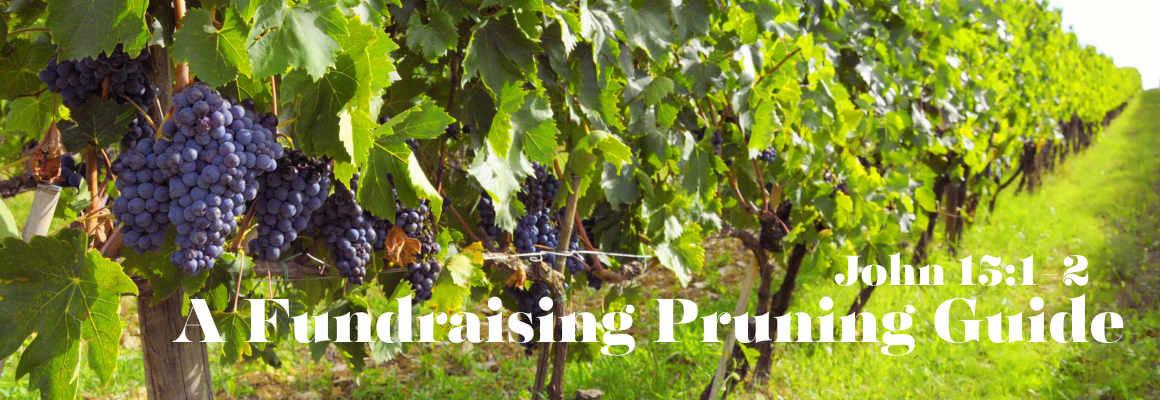
Wide banner image of a sunlit vineyard with rows of grapevines heavy with dark purple grapes, green leaves filling the foreground, and the text “A Fundraising Pruning Guide” and “John 15:1–2” overlaid on the image.
Fundraising Verse of the Week

A Fundraising Pruning Guide

“I am the true vine, and my Father is the gardener. He cuts off every branch in me that bears no fruit, while every branch that does bear fruit he prunes so that it will be even more fruitful” (John 15:1-2).

Pruning your apple tree makes everything better. More air and sunlight get into the tree, which means the apples end up sweeter, prettier, and actually ripen properly instead of staying small and sour. It’s like the tree gets to focus its energy on making fewer but way better apples. Jesus used this same principle when talking about spiritual growth, and it applies perfectly to fundraising. Sometimes the best thing you can do for your organization is not to add more programs or events, it’s to cut away what’s not working.

When Events Become Energy Drains
That annual silent auction your board started five years ago? The one that now requires six months of planning, exhausts your volunteers, and barely breaks even after expenses? It might be time for some pruning. Just because something worked once doesn’t mean it deserves to live forever. Good fundraising events should energize your mission, not drain it. If an event isn’t pulling its weight financially or building meaningful relationships with donors, it’s stealing resources from activities that could actually bear fruit.

The SYBUNT Problem
Every nonprofit has donors who gave “Some Year But Unfortunately Not This Year.” They clutter your database like dead branches on a tree, and you keep sending them expensive mailings hoping they’ll give again. But here’s the tough truth: if someone hasn’t given in three years, they’re probably not coming back through your regular appeals. Instead of letting these dormant donors drain your mailing budget, try one targeted re-engagement campaign. If that doesn’t work, move them to an inactive list. Your active donors deserve your full attention and resources.

Pruning Your Team
Not every development staff member is going to thrive in fundraising. You can measure activity all day long: phone calls made, emails sent, events attended, but at the end of the year, the question is simple: did they raise money? Great fundraisers don’t just maintain existing donors; they bring in new ones. If someone consistently struggles to build relationships and secure gifts, they might be better suited for a different role. It’s not mean – it’s honest stewardship.

Your Most Precious Resource: Time
As a leader, your calendar is like a garden plot. Every plant competes for the same limited space. That weekly report that takes three hours to compile? The committee meeting that goes in circles? The administrative tasks that keep you from actually talking to donors? Prune ruthlessly. Your highest and best use of time is identifying, cultivating, and asking major donors. Everything else should be delegated, streamlined, or eliminated.

Think About This: Remember, pruning isn’t punishment – it’s preparation for growth. When you cut away what’s not working, you create space for what could flourish. Your remaining programs become stronger. Your staff becomes more focused. Your donors receive better attention. Sometimes the most loving thing a gardener can do is make the hard cuts that allow for new growth.

Response: Lord, please give me wisdom to prune everything (and everyone) that’s not working to make us more effective.

Pile of U.S. dollar bills forming a mound under the headline “When the World Offers Easy Money,” set against a dark background, symbolizing temptation and financial allure.
Fundraising Verse of the Week

When the World Offers Easy Money

“Do not listen to Hezekiah. This is what the king of Assyria says: Make peace with me and come out to me” (2 Kings 18:31).

King Hezekiah was in big trouble. Sennacherib had bulldozed through 46 cities of Judah and surrounded Jerusalem. He boasted, “As for him (Hezekiah), I confined him inside the city Jerusalem, his royal city, like a bird in a cage. I set up blockades against him and made him dread exiting his city gate.”1 Sennacherib’s envoys stood before Jerusalem’s walls to negotiate Israel’s surrender. Their five tempting arguments still speak to ministry leaders considering debt to solve their financial problems.

Your Friends Won’t Help You
“Egypt is a splintered reed of a staff that will pierce the hand of anyone who leans on it” (2 Kings 18:21). Sennacherib dismissed Egypt as unreliable. We’re afraid our donors won’t be there when we need their support. Sometimes the “unreliable allies” excuse masks our own reluctance to make the ask.

We Have What You Need
“Come now, make a bargain with my master, the king of Assyria: I will give you two thousand horses” (2 Kings 18:23). Sennacherib offered immediate resources to solve immediate problems. Today’s equivalent might be bridge loans, lines of credit, or bond financing promising quick solutions to your cash flow challenges. Consider all your options carefully before “making a bargain” with your lending master.

God Told Me
Note Sennacherib’s arrogance, “The Lord himself told me to march against this country and destroy it” (2 Kings 18:25). Perhaps you have a well-meaning advisor suggesting, “God brought us this great deal.” One Christian institution seriously considered bond funding which would have restricted spiritual programming to only 40% of their new facility. Somehow, that doesn’t seem like an answer to prayer.

Take the Easy Way Out
“Then each of you will eat fruit from your own vine and fig tree and drink water from your own cistern, until I come and take you to a land like your own” (2 Kings 18:31-32). Sennacherib’s offer sounded appealing: maintain your lifestyle, avoid the struggle, accept our terms. Borrowed money can build buildings and fund programs, but it often comes with hidden costs, not just financial, but organizational and spiritual.

Everybody Else is Doing It
“Has the god of any nation ever delivered his land from the hand of the king of Assyria?” (2 Kings 19:12). Sennacherib argued that every other kingdom had fallen to his superior resources. Ministry leaders often hear “all successful organizations leverage debt” or that fundraising simply “isn’t realistic” in today’s economy. Financing isn’t necessarily wrong, but it may not be God’s intended path for your organization’s current challenge.

Think About This: Hezekiah took Sennacherib’s letter and “went up to the temple of the Lord and spread it out before the Lord” (2 Kings 19:14). “That night the angel of the Lord went out and put to death a hundred and eighty-five thousand in the Assyrian camp.” (2 Kings 19:35). The same God who delivered Jerusalem from overwhelming odds can provide for your ministry’s needs.

Honeycomb pattern with bees on a light background and the text “Honest Fundraising” centered, conveying transparency, integrity, and trust in fundraising efforts.
Fundraising Verse of the Week

Honest Fundraising

“Titus not only welcomed our appeal, but he is coming to you with much enthusiasm and on his own initiative… Therefore show these men the proof of your love and the reason for our pride in you, so that the churches can see it” (2 Corinthians 8:17, 24).

Have you ever avoided telling a donor you’re coming to ask for money when you set up a meeting? Paul didn’t beat around the bush. He told the Corinthians straight up Titus was coming to collect the money they had promised to give. Whether you’re setting up a meeting to ask for a donation or following up on a pledge, tell your donor exactly why you want to meet. Honesty gets great results:

Builds Respect and Trust
When you’re upfront about what you want, you’re treating people like smart adults who can make their own choices. Honesty becomes your strongest tool—one sneaky conversation can mess up relationships for years, but being straight with people builds trust that lasts. Be clear right from your first phone call: “I’d love to meet with you to share what we’re doing and see if you might want to help support us.”

Lets People Get Ready
When donors know why you’re coming, they can think of good questions, figure out what they might be able to give, and maybe bring their spouse or financial advisor into the conversation. This shows you respect their time and see them as partners, not just people with money. Being clear about what you want keeps the relationship strong no matter what they decide about giving.

Creates Real Partnership
Giving benefits the ministry and the donor. Think long-term friendship, not a one-time deal. You’re not just asking for money—you’re giving people a chance to be part of something eternal while helping them reach their giving goals. Focus on what’s important to them: what they care about, what interests them, and their desire to make a difference. This changes how you think about conversations from “I need something from you” to “I’ve got something exciting to share with you.”

Gets Rid of Stress and Works Better
Being honest makes fundraising way less stressful for everyone. You don’t have to worry about finding the “perfect moment” to bring up money. Donors like knowing what to expect, which means they don’t have their guard up and you can have more natural, helpful conversations. This honest approach often leads to bigger gifts because people feel respected and informed instead of tricked. People are more likely to say yes when they’ve had time to think about your request; even when they can’t give, they appreciate the approach.

Think About This: One fundraiser schedules meetings this way: “The best part of my job is meeting with people who care about what we’re doing. I’d love to share the exciting things God is doing through our work and ask if you’d like to join us through prayer and giving. When would be a good time to get together?” This honest, excited approach sets the right tone from the beginning.

Response: Father, help me always be honest when I talk to people about our work. Give me wisdom as I invite people to pray and give generously.

Two silhouetted figures standing side by side against a muted, abstract background with the title Mission-Fit Donors displayed on the image on the other side of the image 3 John 9,12.
Fundraising Verse of the Week

Mission-Fit Donors

“I wrote to the church, but Diotrephes, who loves to be first, will not welcome us” (3 John 9). “Demetrius is well spoken of by everyone” (3 John 12).

The contrast between Diotrephes and Demetrius in 3 John provides a striking illustration of the difference between toxic and healthy donors. Understanding these patterns can help you avoid destructive donor relationships and focus your efforts on mission-aligned supporters.

Diotrephes – The Toxic Donor
Imagine someone rejecting the Apostle John—”the disciple whom Jesus loved” (John 21:7), the same John who penned “God is love” (1 John 4:16). Incredibly, some people didn’t love John, and unfortunately some people don’t love your ministry. Diotrephes-type donors are self-focused, demand excessive recognition, micromanage organizations, or withdraw support when they don’t get their way. Watch for these warning signs:

Closed doors: Diotrephes pulled back the welcome mat for John. Donors who are not mission-aligned usually aren’t looking for opportunities to “be generous on every occasion” (2 Cor. 9:11). You can knock on their door all day, but they won’t answer.

Divisive influence: Diotrephes spread “malicious nonsense” about John. Occasionally, donors who oppose you will “falsely say all kinds of evil against you because of me” (Matt. 5:11). Ask God to silence them (see Psalm 31:18).

Self-serving gatekeeping: Diotrephes didn’t just refuse to support traveling missionaries—he actively prevented others from giving or helping. Some donors may work against you to keep you from sharing your message with others (see 2 Thess. 2:16).

Consider Eric, a successful “Christian” real estate developer who gave to a secular university that named a building after him. When a Christian college president attempted to cultivate a relationship with him, Eric questioned whether a college of 2,000 students was worth his attention compared to a university of 40,000. He failed to see the eternal value of Christian higher education. After investing considerable time in cultivation, the president wisely redirected his efforts toward donors who were genuinely mission-aligned.

Demetrius – The Healthy Donor
Thankfully, Diotrephes wasn’t the only voice in the church. Demetrius had a sterling reputation—he was “well spoken of by everyone” and “by the truth itself (3 John 12).” His alignment with John was clear. Everyone recognized his integrity. Healthy donors don’t listen to criticism from others. They understand your commitment to truth and stand with you.

Paul and Linda participated in a feasibility study for a small classical Christian school. When asked what range of gift they might consider, they joyfully responded, “This school has made a tremendous impact in our children’s lives and we plan to give $1 million!” They are a perfect example of “the millionaire next door” – humble, gracious, and ready to make an eternal difference.

Think About This: You can’t say the right thing to the wrong person, or the wrong thing to the right person. Toxic donors will never give up on their agendas, while healthy donors will never give up on you. Rather than trying to appease donors with self-serving motivations, invest your time and energy in relationships with those who genuinely share your mission and values.

Response: Lord, please grant me discernment to navigate challenging donor relationships. Help me cultivate mission-aligned supporters who will truly partner with our ministry for your kingdom’s sake.

quotation marks Nighttime city skyline with glowing lights stretching across the horizon, overlaid with the text Worried About Many Fundraising Things and a scripture reference, conveying busyness and overwhelm in fundraising.
Fundraising Verse of the Week

Worried About Many Fundraising Things

“Martha, Martha,” the Lord answered, “you are worried and upset about many things,  but few things are needed—or indeed only one. Mary has chosen what is better, and it will not be taken away from her” (Luke 10:41-42).

Martha had a servant’s heart and wanted everything to be perfect for Jesus. No doubt her meal was a lovely Jewish feast with a fish course, soup, a main course of meat or poultry, followed by dessert. Naturally, there were more tasks to complete than time to do them. Luke records, “Martha was distracted by all the preparations that had to be made” (vs. 40).  So, Martha asked Jesus to tell Mary to help her prepare. Jesus gently rebuked her and reminded her to focus on what mattered most—cultivating a relationship with him.

Fundraisers also face the distraction of many competing priorities. Each task seems important, but you must prioritize among many good things to focus on the most important—cultivating relationships with your key donors.

Many things
What are your “many fundraising things”? Fundraisers live in an intense, fast-paced environment juggling multiple tasks simultaneously—coordinating volunteers, managing donor communications, overseeing events, and tracking financial goals. The constant pressure to meet deadlines, respond to donor inquiries, and adapt to unexpected challenges creates a whirlwind of activity that demands your every waking moment.

Few Things
Martha was worried and upset about many things, but Jesus said only a few things were needed. It’s easy to fall into the fundraising trap of “just one more event.” Before agreeing to the next ice bucket challenge, ask yourself: Does this event deepen my relationships with donors, or is it simply another activity without fundraising focus or return on investment? It’s much better to do a few things well than many things haphazardly. More activities don’t necessarily mean greater productivity.

Better Things
Fundraising is a constant struggle between making things complex or keeping them simple. Sometimes we confuse our donors when we try to do too many things at once—running multiple campaigns and sending mixed messages. If you can’t clearly communicate your campaign story in sixty seconds, it’s too complicated. The best fundraisers keep their message concise by telling one clear story and making it easy for people to understand your mission and how they can partner with you.

One Thing
John 12:2 records the second time Martha hosted Jesus, “Here a dinner was given in Jesus’ honor. Martha served, while Lazarus was among those reclining at the table with him.” Martha again served but this time she was not distracted with busyness. She had learned to cherish spending time with Jesus. The highest and best use of your fundraising time this week is investing quality time in cultivating relationships with your key donors. Everything else should take second place.

Think About This: If you’re going to conduct an orchestra, you must turn your back on the crowd. Likewise, if you prioritize cultivating donor relationships, you must say no to many good but distracting fundraising activities. Martha finally chose wisely. Will you?

Response: Lord, please remove the clutter from my calendar and schedule some divine appointments. Prompt me with the name of one key donor you want me to contact this week.

Stacked stones arranged in balanced formations on a neutral background, symbolizing stability, restoration, and rebuilding donor trust, with the title Rebuilding Donor Trust displayed above the image
Fundraising Verse of the Week

Rebuilding Donor Trust

“David was greatly distressed because the men were talking of stoning him; each one was bitter in spirit because of his sons and daughters. But David found strength in the Lord his God” (1 Samuel 30:6).

Are donors throwing rocks at you? Donors often direct their frustration toward leadership when their favorite programs are cut, or trusted staff members are dismissed. David fled from King Saul and settled in Ziklag. One day while he was out raiding, Amalekites burned Ziklag to the ground and captured all the wives and children. When David and his men returned to find their homes and families gone, his men’s grief turned to rage against David. In their despair, they even talked about stoning him. David’s remarkable recovery reveals five essential strategies for regaining donor confidence.

Find Strength in the Lord
David responded by turning to the Lord for strength and wisdom. Trials are important moments of personal and organizational growth. Paul prayed for the Colossian believers to be, “strengthened with all power according to his glorious might so that you may have great endurance and patience” (Col. 1:11). Do you need great endurance and patience today?

Drain the Pain
David’s men had legitimate reasons for their anger, but David wasn’t a detached leader—he grieved alongside them. Donors who are passionate about your ministry hold strong opinions about ministry direction and may question your strategic decisions, especially when staff cuts affect people they know personally. Allow them to express their feelings fully. Acknowledge their pain before moving toward solutions.

Seek Clear Direction
David inquired of the Lord (1 Sam. 30:8) and asked specific questions: “Should I pursue them? Will I overtake them?” Pray specific prayers and look for specific answers. Don’t simply present your strategic plan to God and ask him to bless it. Begin your planning process with prayer, seeking divine wisdom before charting your course.

Solve Problems
Winston Churchill observed, “Criticism may not be agreeable, but it is necessary. It fulfills the same function as pain in the human body. It calls attention to an unhealthy state of things.” David’s pain drove him to pursue God and address his crisis. God answered David’s prayer spectacularly: “David recovered everything the Amalekites had taken” (1 Sam. 30:18). Pain often precedes a breakthrough.

Share Your Blessings
David glorified the Lord for his protection and victory. When he returned to Ziklag, he shared plunder with the elders of Judah who were his friends. When God provides solutions to your fundraising challenges, be generous with your time and experience. Share your learnings with other ministry leaders so they can succeed as well. Maintain a kingdom mindset and celebrate others’ victories.

Think About This: The winter at Valley Forge was a period of immense suffering for the Continental Army. Soldiers faced starvation, disease, and inadequate clothing. Washington, under criticism and doubts about his leadership, turned to prayer for guidance and strength. The path through crisis requires divine dependence and obedience. David’s experience demonstrates that even when facing overwhelming opposition, leaders who anchor themselves in God’s strength can navigate through seemingly impossible circumstances and emerge stronger.

Response: Lord, please help me find my strength in you. Help me inquire of you to know the next steps for our ministry.

Top-down view of a diverse group of professionals in business attire stacking their hands together, with text reading Fundraising Takes a Team Effort.
Fundraising Verse of the Week

Fundraising Takes a Team Effort

“I also told them about the gracious hand of my God on me and what the king had said to me. They replied, ‘Let us start rebuilding.’ So they began this good work” (Nehemiah 2:18).

One of the fastest paths to fundraising burnout is the dangerous assumption that you must shoulder every responsibility alone. Perhaps you’re a one-person shop with seemingly no available help. Maybe you believe that delegating means compromising quality or speed. This mindset undermines your personal well-being and organizational effectiveness.

We credit Nehemiah for rebuilding Jerusalem’s walls, yet success required the entire community working together. Nehemiah 3 lists every family, their specific responsibilities, and the exact sections they rebuilt. Successful fundraising happens when everyone in your ministry identifies, cultivates, and solicits donors.

Everyone Has a Role
From priests and temple gatekeepers to goldsmiths and perfume-makers, from government officials to ordinary merchants, everyone got involved. No role was insignificant. Fundraising is not just the executive director or development professionals’ job. Every team member can and should share your organization’s story. Similarly, every donor matters regardless of giving capacity. Whether someone contributes $100 or $100,000, each gift represents personal sacrifice and builds momentum toward your fundraising goals.

Work Where You Are
Families specifically “repaired the section opposite his house” or adjacent to their neighborhoods (Neh. 3:10,23,28,29,30). They assumed responsibility for areas closest to them. Focus your personal fundraising efforts within your sphere of influence. Coaches should prioritize relationships with dedicated fans and alumni athletes. Professors should cultivate connections with scholarship donors who support their specific programs. Youth workers should engage families whose children have benefited from their ministry. Genuine relationships always outperform generic, impersonal fundraising appeals.

Lead by Example
Eliashib the high priest and his fellow leaders demonstrated servant leadership by getting their hands dirty to build their section rather than merely telling others what to do. Leaders must be committed to fundraising, not just delegating tasks to staff members. When leaders demonstrate genuine enthusiasm for sharing your ministry’s story and personally asking for gifts, others are inspired and confident to get involved.

The Cost of Non-Participation
Nehemiah included an uncomfortable detail: certain nobles “would not put their shoulders to the work” (Neh. 3:5). Are there people in your ministry who sit and watch you do all the work? Pride, apathy, or fear often prevents people from engaging in fundraising. Unfortunately, their lack of participation forces others to pick up the slack.

Complete the Task
Nehemiah’s builders understood that leaving any gaps in their defensive wall would compromise the entire city. Your ministry also needs to fill in all the gaps on your donor giving pyramid: major donors, recurring donors, mid-level donors, first-time donors, foundations, churches, and legacy donors. Employ strategies to reach each segment.

Think About This: “So the wall was completed… in fifty-two days” (Neh. 6:15). The wall wasn’t built by one person working alone for years—it was completed by everyone working together for weeks. Imagine the transformative impact if every person in your organization committed to personally introducing just ten people to your ministry this year.

Response: Lord, forgive me for attempting to accomplish our mission by myself. Give me wisdom to effectively engage others in this significant work.

describe this picture for the purpose of alt text on a website, no quotation marks
Fundraising Verse of the Week

Shrewd Donors

“Here’s the lesson: Use your worldly resources to benefit others and make friends. Then, when your earthly possessions are gone, they will welcome you to an eternal home” (Luke 16:9 NLT).

In the Parable of the Shrewd Manager, a rich man informs his manager that he will be fired for mismanaging his master’s resources (see Luke 16:1-15). The steward makes a bold move to provide for himself once he’s unemployed. He cuts some incredible quid pro quo deals with the top debtors. If they helped him, he would immediately reduce their debt. When the master learns what his clever servant has done, you would think he would be in hot water for cheating his master. Instead, the master commends him for his shrewdness. Jesus does not want us to emulate the servant’s unscrupulous business dealings, but his wise use of worldly wealth to provide for his future.

Worldly Resources
John Wesley approached money with three principles, “Having first, gained all you can, and secondly saved all you can, then give all you can.” As a fundraiser you can influence believers to make good stewardship decisions. Your donors are in various stages of their Christian walk. Some view their resources in light of eternity, but many struggle with “the deceitfulness of wealth and the desires for other things” (Mark 4:19). Having money is not a sin. Using it selfishly is.

Make Friends
Jesus challenges believers to, “use your worldly resources to benefit others and make friends” (Luke 16:9 NLT). Whom are these friends? Matthew 25:35-36 explains, “For I was hungry and you gave me something to eat, I was thirsty and you gave me something to drink, I was a stranger and you invited me in, I needed clothes and you clothed me, I was sick and you looked after me, I was in prison and you came to visit me.” Introduce your donors to these friends—the hungry, thirsty, naked, sick, strangers, and prisoners. Their gifts will introduce these friends to the true Friend.

Eternal Home
Heaven will be a welcome home party for your donors. Ray Boltz captures this theme in his song Thank You, “A missionary came to your church—And his pictures made you cry—You didn’t have much money—But you gave it anyway—Jesus took the gift you gave—And that’s why I’m here today—Thank you for giving to the Lord—I am a life that was changed.” You must help your donors understand the eternal impact of their generosity.

Love Money
The Pharisees who heard this parable sneered at Jesus because they loved money (see Luke 16:14-15). Jesus emphasized this truth, “No one can serve two masters. Either you will hate the one and love the other, or you will be devoted to the one and despise the other. You cannot serve both God and money” (Luke 16:13). Unfortunately, some of your donors are serving the wrong master. You can help them.

Think About This: One day your donors will receive rewards for laying up their treasures in Heaven. Some might thank you for asking them to support your ministry. Some may even ask you, “Why didn’t you ask me for more?”

Response: Father, help me encourage my donors to become shrewd donors who give generously.

Nighttime nativity silhouette with a bright star shining over a manger and three wise men on camels, set against a star-filled sky, with text reading The Indescribable Gift.
Fundraising Verse of the Week

The Indescribable Gift

“Thanks be to God for his indescribable gift!” (2 Corinthians 9:15)

We take great care when selecting the perfect gift for that special person, but nothing compares with our Heavenly Father’s gift of his only Son to be “an atoning sacrifice for our sin” (1 John 4:10). Praise God for his generous, sacrificial gift of salvation! Without God’s generosity to us, we would be eternally lost and without hope. Paul responded to God’s gift with this doxology of praise. How should you respond to the generosity of your donors? Gifts from your ministry partners accomplish four results.

Practical
Henry Ford said, “Nothing happens until someone sells something.” In ministry, nothing happens until someone gives something. Generosity starts a chain reaction of blessing. “This service that you perform is… supplying the needs of the Lord’s people” (2 Cor. 9:12). Gifts solve real problems and enable you to serve others. With a balanced budget you can educate more students, feed more hungry people, and reach more people with the Gospel. More money means more ministry.

Personal
Your ministry benefits when donors give, their generosity also demonstrates the genuineness of their faith. Because of the service by which you have proved yourselves” (2 Cor. 9:13). Giving is an expression of “the obedience that accompanies your confession of the gospel of Christ” (vs. 13). James warns us that faith without works is dead. What good is it, my brothers and sisters, if someone claims to have faith but has no deeds? Can such faith save them?  Suppose a brother or a sister is without clothes and daily food. If one of you says to them, ‘Go in peace; keep warm and well fed,’ but does nothing about their physical needs, what good is it?” (James 2:14-16). Giving transforms mere talk into action.

Praise
Generous giving prompts “many expressions of thanks to God” (vs. 12). Great news about a generous gift spreads like wildfire. “Others will praise God for… your generosity in sharing with them and with everyone else” (2 Cor. 9:13). Share with your donors how their gift is making an eternal difference and how your whole team is thanking God because of their generosity. Tell an impact story that would not have happened without their gift. Thank them for sharing with you and the other ministries they support.

Prayer
We are encouraged to pray for missionaries who are sharing the gospel throughout the world. Many donors don’t realize that those who benefit from their generosity are also praying for them. “And in their prayers for you their hearts will go out to you, because of the surpassing grace God has given you” (vs. 14). The greatest way to thank your donors is to pray for them. Ask for their prayer requests, spend time praying for them, and follow up to hear how God has answered.

Think About This: So many great things happen when donors give generously. You have the privilege of asking your donors to partner with you to accomplish eternal work. This week thank your donors for their generous, sacrificial gifts to your ministry.

Response: Father, I am so thankful to you for our donors. Please help me express my gratefulness to my donors in ways that give you all the glory.

a row of five light bulbs on a golden background with one bright compact fluorescent bulb glowing in the center, accompanied by the title fundraising know how and a small scripture reference in the lower right corner.
Fundraising Verse of the Week

Fundraising Know How

“See, I have chosen Bezalel son of Uri… and I have filled him with the Spirit of God, with wisdom, with understanding, with knowledge and with all kinds of skills” (Exodus 31:2-3).

God gave Moses the intricate plans for the Tent of Meeting, the ark of the covenant, and all its furnishings. He also assigned Bezalel to create all these holy items. In today’s vernacular we would call him a “maker.” Bezalel knew everything about everything—a jack of all trades. He was a master metalsmith, stonecutter, woodworker, seamster, leatherworker, and a perfumer (see Exo. 31:4-11). Bezalel became this gifted artisan because the Holy Spirit filled him with supernatural wisdom, understanding, knowledge, and skill. The Spirit can also fill you with fundraising know-how.

Wisdom
God came to Solomon in a dream and said, “Ask for whatever you want me to give you” (1 Kings 3:5). Solomon could have asked for long life, wealth, or the death of his enemies. Instead, he asked for wisdom. If you were answering for your ministry, how would you respond? Would you ask for a balanced budget? New buildings? More staff? More people to serve? Most ministry leaders would ask for a huge endowment. Instead, you should seek God’s wisdom to fundraise well.

Understanding
“Trust in the Lord with all your heart and lean not on your own understanding” (Prov. 3:5). You make decisions every day, how many of those decisions do you pray about? How often do you inquire of the Lord about your right next fundraising step? The tribe of Issachar were “men who understood the times and knew what Israel should do” (1 Chron. 12:32). Some nonprofits understand their financial needs but don’t seem to understand that they must cultivate relationships with donors who could help meet those needs.

Knowledge
Knowledge is the accumulation of facts and data that you acquire through study, research, investigation, observation, or experience. How have you increased in your general fundraising knowledge? More importantly, how have you increased your knowledge about your key donors? Fundraising is about relationships. Who do you know? How are you connected? What are your donors’ giving interests? When is the best time to ask? What projects get them excited? Get to know your major donors.

Skill
Solomon hired Huram to work on the Temple. He also was a skilled craftsman who “was filled with wisdom, with understanding and with knowledge to do all kinds of bronze work” (1 Kings 7:14). It takes practice to become a skilled craftsman. Likewise, it takes practice to become a skillful fundraiser. The best learning is not in a classroom but in the field talking with major donors. Asking is the most important skill a fundraiser must develop. Refine your asking skills by asking more.

Think About This: Fundraising wisdom, understanding, knowledge, and skill starts with being filled with the Spirit. God gives you the same opportunity he gave Solomon. “If any of you lacks wisdom, you should ask God, who gives generously to all without finding fault, and it will be given to you” (James 1:5).

Response: Father, when it comes to my fundraising efforts, please “fill me with the knowledge of your will through all the wisdom and understanding that the Spirit gives” (Col. 1:9).

1 2 3 32 33
Cart Overview